US governor defends ban on African American history course
January 23, 2023
The Republican leader of the US state of Florida defended his ban on an African American studies course Monday, railing against its pushing of “social justice” topics such as “queer theory.”
“We want education, not indoctrination. If you fall on the side of indoctrination, we’re going to decline. If it’s education, then we will do (it),” Governor Ron DeSantis, who is considered one of the favorites for his party’s 2024 presidential nomination, told reporters.
“This course on Black history: what is one of the lessons about? Queer theory. Now who would say that an important part of Black history is queer theory? That is somebody pushing an agenda on our kids,” he added.
The class covers more than 400 years of African American history and is being rolled out as part a nationwide “advanced placement” program giving high school students the chance to take college-level subjects before graduation.
But Florida’s Department of Education has objected to the inclusion of “Black Queer Studies” and topics such as Black feminism and the alleged promotion of critical race theory, an academic discipline investigating systemic racism in American society.
Officials have also complained about its approach to the debate over reparations — the argument for compensating Black Americans for slavery — telling organizers the program violated state law and rejecting its inclusion in Florida schools.
DeSantis has seen his political stock rise following a big election win in November and he is now considered former president Donald Trump’s main rival in the race for the 2024 Republican nomination.
He has gained support on the right for his hardline stances on “culture war” issues such as public health restrictions during the pandemic and alleged “woke” indoctrination in education.
He argued Monday that the purpose of education was the “pursuit of truth,” and not to use schools as “an instrument of what they consider social justice and social change.”
“We believe in teaching kids facts and how to think, but we don’t believe they should have an agenda imposed on them,” DeSantis said. “When you try to use Black history to shoehorn in queer theory, you are clearly trying to use that for political purposes.”
The decision to block the course has been met with outrage from the American Civil Liberties Union, which said DeSantis had “no right to censor speech he disagrees with” while Vice President Kamala Harris said at the weekend anyone banning teaching US history “has no right to shape America’s future.”
Biden’s Cabinet is sticking around, bucking the turnover trend of his predecessors
Peter Nicholas and Carol E. Lee – January 23, 2023
Jim Watson
WASHINGTON — Ron Klain’s imminent departure as the White House chief of staff is the first step in a broader reshuffling among President Joe Biden’s advisers as he prepares for a 2024 re-election bid.
Jeff Zients, who led the Biden administration’s Covid-19 response, is set to replace Klain, and other White House aides are expected to leave in the coming months and shift over to the campaign, sources said.
But one part of Biden’s administration has been unusually stable, and it looks to stay that way for the foreseeable future: the Cabinet secretaries who run the sprawling federal government. Not one of the 15 department heads in the presidential line of succession quit in the first half of Biden’s term, nor have any given notice that they plan to leave any time soon, White House officials said.
The absence of turnover among the Biden appointees — whose jobs include stopping crime, keeping food safe and guarding against attack — is a rarity. Since Ronald Reagan’s presidency in the 1980s, only Barack Obama had no one from the Cabinet step down by the midpoint of his first term, said Kathryn Dunn Tenpas, a senior fellow at the Miller Center, a think tank on the presidency at the University of Virginia.
By contrast, Donald Trump churned through Cabinet secretaries as president — and senior staff members — at a head-spinning clip; nearly half his Cabinet had turned over as he entered his third year in office. By early 2019, Trump had cycled through seven of 15 Cabinet secretaries and was on his third chief of staff.
“Not one single member of the Cabinet has left in disgrace, is writing a tell-all book or has bad-mouthed the president,” said Sen. Chris Coons, D-Del., who is close to the Biden White House. “There are no leaks, no backbiting, nothing.”
The new Republican-controlled House may try to yank at least one from his job. Some GOP House members hope to impeach Homeland Security Secretary Alejandro Mayorkas in reprisal for what they see as lax immigration enforcement at the U.S.-Mexico border. A White House official said Mayorkas would fight any such attempt and has no wish to step down.
The durability of Biden’s Cabinet is something of a surprise. Before the midterm elections in November, some administration officials believed Cabinet departures hinged on whether Democrats kept control of the Senate. The thinking was that Cabinet officials would feel freer to leave because Biden would have an easier time getting a successor confirmed by the Senate than if Republican leader Mitch McConnell ran the chamber.
Democrats, indeed, kept the Senate, but the exodus from the Cabinet didn’t happen. In an interview after the midterms, Treasury Secretary Janet Yellen said she wasn’t planning to leave before the term was over, despite the more favorable climate for confirmation.
“We have a lot of work to do,” she said in November. (There had been continual speculation that Yellen would leave and be replaced by Commerce Secretary Gina Raimondo, who in turn would be succeeded by Terry McAuliffe, the former governor of Virginia. When the Yellen domino didn’t fall, the others stayed in place.)
Why Cabinet members stay put rather than take better-paying jobs in the private sector or embark on independent political careers may have something to do with how they’re treated. Biden has made it a point to show them they’re valued, aides argue.
Before he gives a speech to a union group, he’ll call Labor Secretary Marty Walsh to make sure he is comfortable with the text, said Anita Dunn, a senior White House adviser. When a businessperson raises a concern with him, he’ll pick up the phone and call Raimondo.
Few members of Biden’s Cabinet are strangers. Energy Secretary Jennifer Granholm played the part of Republican vice presidential candidate Sarah Palin during Biden’s debate preparation in the 2008 campaign. Biden thoroughly vetted Raimondo as a potential vice presidential pick in 2020.
“This is a president who really uses his Cabinet and values his Cabinet,” Dunn said. “Often, Cabinet members feel as though they are disconnected from the White House. In this case, the president has really depended on his Cabinet for advice.”
“They are a group of people that he has deep relationships with and who he listens to and seeks wisdom from that’s broader than their Cabinet agencies,” she added.
Going back decades, presidents have steadily concentrated power in the White House, at the Cabinet’s expense, historians say. Some Cabinet secretaries have felt marginalized as presidents stocked the West Wing with trusted advisers and usurped the prerogatives of Cabinet members who had thought they were brought in to run things.
The most glaring examples are in the foreign policy realm. Presidents have steadily padded the White House’s National Security Council with staff members who have, in some cases, left the secretary of state isolated. President Richard Nixon entrusted his national security adviser, Henry Kissinger, with his most sensitive and consequential foreign policy goals, diminishing Secretary of State William Rogers.
Trump had no rapport with his first secretary of state, Rex Tillerson, who once privately referred to him as a “moron” and was eventually fired by tweet.
But Biden is more of an institutionalist, having helped vet and confirm Cabinet secretaries throughout his 36 years as a senator. He also has an affinity with some members of his Cabinet forged through a long career in politics.
“Biden’s inner circle is so close-knit it’s almost familial,” said Chris Whipple, who recently published a book about Biden’s presidency. “It’s not so much a team of rivals but a bunch of team players. Those are just the people he chose. They’ve been pretty cohesive, and I don’t see a whole lot of movement.”
Biden and Secretary of State Antony Blinken have worked together for two decades, starting in the early 2000s, when Biden chaired the Senate Foreign Relations Committee and Blinken was the Democratic staff director.
Asked about Blinken’s primacy in foreign policy matters, Dunn said Biden’s “relationship with Tony is so deep and goes back so far that it’s just a given.” She laughed.
Another enticement for the Cabinet to stay is that the next two years may be more fun. After grinding negotiations, Biden spent the first two years passing trillion-dollar infrastructure and climate change bills that it’s the Cabinet’s job to implement. That means ribbon-cuttings and visits to grateful states — all of which are helpful in cementing legacies in office.
“It’s just like any job,” said Tenpas of the Miller Center. “When there’s success, you want to keep doing it.”
How Kevin McCarthy Forged an Ironclad Bond With Marjorie Taylor Greene
Jonathan Swan and Catie Edmondson – January 23, 2023
House Minority Leader Kevin McCarthy (R-Calif.), fist bumps with Rep. Marjorie Taylor Greene (R-Ga.) as he arrives for a photo with freshman GOP members of the 117th Congress on the East Steps of the Capitol Building in Washington, on Jan. 4, 2021. (Anna Moneymaker/The New York Times)
WASHINGTON — Days after he won his gavel in a protracted fight with hard-right Republicans, Speaker Kevin McCarthy gushed to a friend about the ironclad bond he had developed with an unlikely ally in his battle for political survival, Rep. Marjorie Taylor Greene of Georgia.
“I will never leave that woman,” McCarthy, R-Calif., told the friend, who described the private conversation on the condition of anonymity. “I will always take care of her.”
Such a declaration from McCarthy would have been unthinkable in 2021, when Greene first arrived on Capitol Hill in a swirl of controversy and provocation. A former QAnon follower who had routinely trafficked in conspiratorial, violent and bigoted statements, Greene was then widely seen as a dangerous liability to the party and a threat to the man who aspired to lead Republicans back to the majority — a person to be controlled and kept in check, not embraced.
But in the time since, a powerful alliance developed between Greene, the far-right rabble-rouser and acolyte of former President Donald Trump, and McCarthy, the affable fixture of the Washington establishment, according to interviews with 20 people with firsthand knowledge of the relationship, many of whom spoke on the condition of anonymity to discuss it.
Their political union — a closer and more complex one than has previously been known — helps explain how McCarthy rose to power atop a party increasingly defined by its extremes, the lengths to which he will go to accommodate those forces, and how much influence Greene and the faction she represents have in defining the agenda of the new House Republican majority.
“If you’re going to be in a fight, you want Marjorie in your foxhole,” McCarthy said. Both he and Greene agreed to brief interviews for this article. “When she picks a fight, she’s going to fight until the fight’s over. She reminds me of my friends from high school, that we’re going to stick together all the way through.”
It is a relationship born of political expediency but fueled by genuine camaraderie, and nurtured by one-on-one meetings as often as once a week, usually at a coffee table in McCarthy’s Capitol office, as well as a constant stream of text messages back and forth.
McCarthy has gone to unusual lengths to defend Greene, even dispatching his general counsel to spend hours on the phone trying to cajole senior executives at Twitter to reactivate her personal account after she was banned last year for violating the platform’s coronavirus misinformation policy.
Greene, in turn, has taken on an outsize role as a policy adviser to McCarthy, who has little in the way of a fixed ideology of his own and has come to regard the Georgia congresswoman as a vital proxy for the desires and demands of the right-wing base that increasingly drives his party. He has adopted her stances on opposing vaccine mandates and questioning funding for the war in Ukraine, and even her call to reinvestigate the Jan. 6, 2021, attack on the Capitol to show what she has called “the other side of the story.”
McCarthy’s agenda, Greene said, “if he sticks to it, will easily vindicate me and prove I moved the conference to the right during my first two years when I served in the minority with no committees.”
‘Kevin Did This to You’
It was a right-wing conspiracy theory that first came between McCarthy and Greene, but not in the way that many people think.
When Greene entered Congress in January 2021, Republican leaders viewed her as a headache, and McCarthy regarded her as potentially beyond redemption. During her primary, social media posts had emerged in which she embraced the QAnon conspiracy theory and warned of “an Islamic invasion of our government.”
Rep. Steve Scalise of Louisiana, the No. 2 Republican, had intervened to oppose Greene — an affront she would not forget — but McCarthy, who eschews confrontation and conflict, would not go that far. He issued a statement through a spokesperson condemning the statements, but did not endorse her opponent.
Weeks after Greene was sworn in, more conspiracy-laden posts surfaced, including diatribes in which she had questioned whether a plane really flew into the Pentagon on Sept. 11, 2001, and endorsed the executions of Democratic politicians including Speaker Nancy Pelosi and President Barack Obama.
Outraged Democrats demanded that McCarthy oust her from congressional committees, and when he made no move to do so, they scheduled a vote to do it themselves. As the pressure built, some of Greene’s far-right allies told her yet another conspiratorial story that she believed: McCarthy, they said, was secretly working with Pelosi to strip her of power.
Enraged, Greene stormed into McCarthy’s office in the Capitol late one night in February 2021 and handed him a letter signed by Republican leaders in her district, urging him to keep her on her committees. They had received “countless” messages, they said, from their voters who were intent on supporting her.
It served as a not-so-subtle warning to McCarthy that the Republican base would be outraged if he did not ensure she kept her committee seats. McCarthy tried to explain to Greene that he agreed that what Democrats were doing was outrageous, but that as minority leader, he had neither the power nor the votes to stop it.
But Greene did not believe McCarthy, a person familiar with her thinking said. After she was booted off the Education and Budget Committees, members of her inner circle told her, “Don’t forget: Kevin did this to you.”
‘The Principal’s Office’
The relationship remained fraught throughout Greene’s first year in Congress, as the same pattern played out again and again in their interactions. A controversy would erupt over an outrageous comment Greene had made, then McCarthy would summon her to deal with the matter privately.
Greene would joke to friends, “Uh-oh, I’ve been called to the principal’s office.”
But even as she continued to traffic in offensive conspiracy theories and spoke at a white nationalist rally, McCarthy refused to punish her and often refrained from even criticizing her comments until pressed by reporters. It was a calculated choice by McCarthy, who leads more by flattery and backslapping than through discipline.
And by early 2022, Greene had begun to believe that McCarthy was willing to go to bat for her. When her personal Twitter account was shut down for violating coronavirus misinformation policies, Greene raced to McCarthy’s office in the Capitol and demanded that he get the social media platform to reinstate her account, according to a person familiar with the exchange.
Instead of telling Greene that he had no power to order a private company to change its content moderation policies, McCarthy directed his general counsel, Machalagh Carr, to appeal to Twitter executives. Over the next two months, Carr would spend hours on the phone with them arguing Greene’s case, and even helped draft a formal appeal on her behalf.
The efforts were unsuccessful at the time, but they impressed Greene and revealed how far McCarthy was prepared to go to defend her. It was part of a broader and methodical courtship of the hard right by McCarthy that included outreach to conservative media figures and Trump’s hard-line immigration adviser Stephen Miller.
He had studied the two previous Republican speakers of the House, former Reps. John Boehner of Ohio and Paul Ryan of Wisconsin, a person familiar with his thinking said, and concluded that one of their fatal errors had been unnecessarily isolating far-right members, who in turn made their lives miserable. So McCarthy set out to do the opposite.
Approaching Symbiosis
Still, the alliance between McCarthy and Greene did not truly begin to flourish for several more months. At a party in the Dallas suburbs at the home of Arthur Schwartz, a GOP consultant and outside adviser to McCarthy, Greene found herself in the corner of a great room chatting with Devin Nunes, a former top Republican on the Intelligence Committee and a committed Trump ally.
Nunes told Greene about the time he had witnessed McCarthy yelling at Rep. Steny Hoyer, D-Md., who was then the majority leader, for his party’s decision to remove Greene from her committees, and threatening that he would do the same to Democrats when Republicans came to power.
Greene recalled it as the first time she had heard from somebody she trusted that McCarthy had defended her, rather than conspired with Democrats to blackball her.
“That conversation had a big impact on me,” she said.
From then on, the two settled into a kind of symbiotic relationship, both feeding off what the other could provide. Greene began regularly visiting McCarthy, frequently dropping by his office, and he began inviting her to high-level policy discussions attended by senior Republicans and praising her contributions.
He was impressed not only by Greene’s seemingly innate understanding of the impulses of the party’s hard-right voters, but also by her prowess at building her own brand. He once remarked to allies with wonder at how Greene, as a freshman, was already known by a three-letter monogram: MTG. “She knows what she’s doing,” McCarthy marveled privately. “You’ve got AOC and MTG.”
After Republicans underperformed expectations in the midterm elections, winning only a narrow majority and guaranteeing that McCarthy would have a tough fight to become speaker, Greene was quick to begin barnstorming the right-wing media circuit as one of his top surrogates, using her conservative credentials to vouch for his.
As her peers on the far-right flank of the party refused to support McCarthy, subjecting the Republican leader to a four-day stretch of defeats, Greene was unflinching in her support, personally whipping votes on the House floor and strategizing on calls with Trump.
Greene’s support for McCarthy created a permission structure for other GOP lawmakers to do the same.
Rep. Barry Moore, R-Ala., said in an interview that when conservatives back home sought an explanation for his support for McCarthy, he would comfort them by replying: “Well, Jim Jordan and Marjorie Taylor Greene are standing with Kevin McCarthy. And so am I.”
The relationship has also paid off for Greene, no longer the fringe backbencher stripped of her power. Republican leaders announced last week that she would serve on two high-profile committees: Oversight and Homeland Security. She is also likely to be appointed to a new Oversight select subcommittee to investigate the coronavirus, according to a source familiar with McCarthy’s thinking who was not authorized to preview decisions that have yet to be finalized.
It is already clear that she is influencing McCarthy’s policy agenda.
After Greene had told McCarthy that vaccine mandates were morally wrong and that he needed to stop them, he fought vociferously — and successfully — to include the repeal of the military coronavirus vaccine mandate in last year’s defense bill.
After she told him that the party faithful could not understand why Congress continued to send money to help Ukraine secure its borders, when the United States’ southern border was not secure, McCarthy helped pave the way for Republicans on the Foreign Affairs Committee to put forward and support a bill sponsored by Greene, who does not sit on the panel, demanding that Congress audit U.S. aid sent to Ukraine.
And after she told McCarthy that many people imprisoned for their actions during the Jan. 6 attack on the Capitol were being victimized, he signaled that Republicans would start an inquiry of their own digging into the work of the panel that was investigating the assault.
“People need to understand that it isn’t just me that deserves credit,” Greene said. “It is the will and the voice of our base that was heard, and Kevin listened to them. I was just a vehicle much of the time.”
In the early hours of Jan. 7, after McCarthy had finally clinched the speakership on the 15th ballot and pallets of Champagne were being wheeled into his new office, Greene opted not to join the celebration. But she sent him a text message the next day telling McCarthy how happy and proud she was — and how she could not wait to get started.
How to solve Arizona’s housing shortage, which has reached crisis levels
Jenn Daniels and Sean Bowie – January 23, 2023
Arizona is short at least 100,000 housing units to keep pace with demand.
As you read this, 300 Americans have just decided to move to our beautiful state. And it keeps happening every day.
Quality of life, low cost of living, climate, low regulatory environment and a simplified tax structure continues to draw people and businesses to Arizona.
Yet keeping up housing supply with this population growth has been challenging. While numbers vary, the Common Sense Institute Arizona estimates a shortage of about 100,000 housing units.
Barriers to development at the local level, bureaucracy within state agencies and preemptive state laws have limited the building of more housing units at a pace that keeps up with our growing population. Often unnecessary, burdensome rules and regulations have delayed project start times and increased costs for developers and homebuilders.
These costs ultimately get passed on to the buyer.
It’ll take steady, deliberate policy to solve this
Simply put, Arizona has a housing crisis – we need more housing, and we need it now. To be clear, there is no fast and easy button that will make the housing shortage go away. The solution is steady, intentional, deliberate policy and collaboration between all levels of government and the private sector.
We are of different political parties, but we have come together to find solutions to the challenges before us. After careful study of the data, dozens of stakeholder interviews and analysis of policy from other states, we have developed a menu of bipartisan solutions as part of a report for the nonpartisan Common Sense Institute Arizona (CSI).
We believe this can be a roadmap for state and local policymakers.
1. Expedite zoning and approval processes
Current processes for obtaining municipal approval to develop a piece of property vary from city to city. The process is burdensome, costly and takes far longer than is practical for builders.
The consistency achieved by establishing a universal, streamlined process for all Arizona cities will enable for a more objective approach. The development of a uniform process at the state level should be collaborative in nature among cities and consider cities of all sizes. Builders and developers would go through the same process regardless of the jurisdiction and get more houses to market more quickly.
In essence, the ideal process to go from empty lot to home for sale would be the same in every municipality. By creating a uniform process, a homebuilder in Surprise would follow the same steps, checklist and timeline as a homebuilder in Chandler or Yuma.
2. Let state Housing department grade cities
Once the state has designed and implemented statutory guidelines around streamlined entitlement, review and permitting processes for residential development, the Department of Housing would review and monitor local processes and grade municipalities using objective standards like how long, expensive and onerous an entitlement and permitting process was.
In reviewing the onerousness of this process, the department would compare the cities performance relative both to other cities and towns in Arizona, and national benchmarks and standards.
Top-performing jurisdictions would have greater opportunity to use the novel tools, and receive some of the new state funding, recommended elsewhere in our report – we believe that when a city knows better, they also want to do better. Having true benchmarks and measurable data that can be tracked and shared openly is the best indicator.
3. Develop statewide zoning definitions
Zoning definitions vary from city to city. Identifying logical and predictable zoning definitions at the state level allows for comparison of zoning between municipalities, transparency in the process, and clarity for developers. Additionally, defining new or innovative types of housing, diversifying the types of housing within a municipality, and providing a cohesive way to update municipal codes will benefit cities, regions and developers.
Housing opportunity zones – which use a percentage of existing tax revenue within a municipality to help fund development – can improve the supply of housing where the market alone is unable to meet demand.
4. Form local ‘Housing Opportunity Zones’
For instance, in Arizona, we utilize a manufacturing Transaction Privilege Tax incentive, wherein we divert state sales-tax dollars to cities to support manufacturing project infrastructure costs, so developers don’t have to front those costs. This played a large role in TSMC’s development of their new $12 billion fabrication plant expanded here in our state.
Likewise, housing opportunity zones would likely be most popular in areas that are ripe for development where there are already significant resources being invested in bringing more housing supply onto the market. Like all policies of this nature, it should have a sunset date and be reviewed by the Legislature.
Developers who construct housing and meet accountability benchmarks could retain a proportion of local sales or property taxes otherwise owed on the project, as a way to compensate for costs associated with building and selling the affordable units. A city or town could also use the monies to reimburse itself for capital costs associated with providing public infrastructure that supports these projects.
5. Help cities fund more affordable housing
The state should encourage cities to create their own affordable housing funding. One way to do this is to create a statewide grant program that incentivizes cities to create dedicated funds that would go towards more affordable housing development.
The city of Tempe has been a leader in this regard, creating its Hometown for All program in 2021. Fifty percent of several development permitting fees paid to the city go into the fund and help finance land acquisition and redevelopment within city borders.
Our full report outlines a total of 19 solutions. These aren’t Republican ideas or Democratic ideas. These are Arizona ideas.
It’s important for everyone address this critical issue together. The success of our state depends on remaining an attractive and affordable place for new businesses and new residents. Together, we can ensure Arizona stays that way.
Jenn Daniels, a Republican, is former mayor of Gilbert and Sean Bowie, a Democrat, is a former Arizona state lawmaker. They served as housing fellows at Common Sense Institute Arizona.
Some of our posts include links to retailers. If you buy something from clicking on one, G/O Media may earn a commission. Because editorial staff is independent of commerce, affiliate linking does not influence our editorial content.
Republicans in Congress are threatening once again to force the US to default because they lack the votes to enact their preferred fiscal vision.
Yes, it’s debt ceiling season once again. For those not following along at home, US law imposes an arbitrary limit on the amount of money the government is allowed to borrow. Historically, this was intended to make borrowing easier. Today, it is a tool for brinksmanship, with Republicans threatening to block paying the bills they already voted to incur unless GOP demands for unspecific spending cuts are met.
Right now, the US is at the limit, and the Treasury Department is moving money around to delay a conflict until later in the year. But if the limit is not raised, the US faces a constitutional crisis: How can the president execute the laws set by Congress if those laws are contradictory? (Here’s a flow chart for your consideration.)
The last time a real debt ceiling face-off happened in 2011, the US had its sovereign debt rating downgraded and incurred more than a billion dollars in economic losses. So let’s set aside the hypocrisy and political posturing and ask a simpler question: Is there a debt crisis that would justify holding the economy hostage?
And the answer is no. Markets are not worried about the US paying its debts, and there are no bond vigilantes appearing out of the woodwork.
That’s because the US is an enormously wealthy nation with a growing economy. The US has a lot of debt, about $22 trillion, equal to about an entire year’s economic production. But the US also has a lot of wealth—about $137 trillion (pdf). It’s true that interest rates are rising, but only because the Federal Reserve is pushing them up. Investors are still betting that rates will fall soon, with the interest paid on ten-year Treasury bonds lower than on government debt due in two years. That yield curve inversion reflects expectations that the Fed will cut rates during a potential recession. But even absent a downturn, the Fed isn’t likely to hike more than expected next year thanks to slowing inflation.
Public debt is stabilizing. How do you shrink it?
And what’s the trend for federal public debt? After a huge surge driven by pandemic-driven public spending, borrowing is set to shrink as a share of the economy in the years ahead. These Congressional Budget Office forecasts are from May 2022, and don’t include changes from legislation like the Inflation Reduction Act or updated economic data, but the figures do offer a best guess at what we can expect:
Many policymakers and economists fret that publicly-held debt approaching 100% of annual GDP is too high. The “correct” level of debt is difficult to assess; researchers think too much debt can be a drag on growth, but only if it crowds out private spending or leads to higher interest rates. The global economy, however, is in many ways dependent on a steady supply of US debt. Perhaps the biggest reason to push down current borrowing is to make sure the US has the fiscal capacity to weather the next emergency. One thing that won’t help reduce the debt, however, is a financial crisis caused by debt ceiling brinksmanship.
Despite the Fed’s tightening, growth remains strong and unemployment is low. That’s arguably a good environment to reduce government spending after the enormous surge in pandemic aid. Spending is already falling faster, as a share of the economy, than it did after the 2008 recession.
There are ways to keep driving spending down (pdf), but they require delivering pain to somebody: Eliminating subsidies to everyone, from agribusiness to defense contractors, leads to lobbyists for affected industries pounding down lawmakers’ doors, while cutting benefits to children, the sick or the poor remains broadly unpopular. Tax hikes can be more palatable but can generate political repercussions among influential upper class voters.
The last time anyone tried to hash out a compromise on all of this—the 2011 glory days of the Bowles-Simpson commission—Republicans backed out because of proposed tax increases, and Congress wound up cutting spending 10% across the board. (Republicans reversed many of the cuts when President Donald Trump took office in 2017.)
Debt politics are different in 2023
Absent the specter of the European debt crisis or a Republican party united on fiscal issues, the politics of debt reduction sit differently. Some Republican politicians, like Trump and Senate leader Mitch McConnell, are already warning that the cuts for popular but expensive programs such as Social Security and Medicare implied by a debt default aren’t going to help the party gain power in the next election. Republican member of Congress Nancy Mace told NBC over the weekend spending must be cut but couldn’t name a single target for reductions. Instead of cuts, conservative Democratic Senator Joe Manchin is pushing to lift the limit on taxable Social Security wages.
It’s easy—it’s always easy—to imagine the Biden White House coming together with Republicans in Congress to find a moderate deficit reduction package that raises taxes and cuts some spending. The White House certainly imagines it, since administration spokespeople such as Treasury Secretary Janet Yellen have made clear it won’t engage with novel plans to avoid a debt ceiling crisis like minting a platinum coin or various other finance shenanigans. Still, the patience—or complacency—about the debt ceiling might leave Washington in an uncomfortable place come this summer: It remains to be seen if the hardliners among Republicans have the patience for bipartisan legislating. If global investors won’t give them the debt crisis they want, they seem eager to create it.
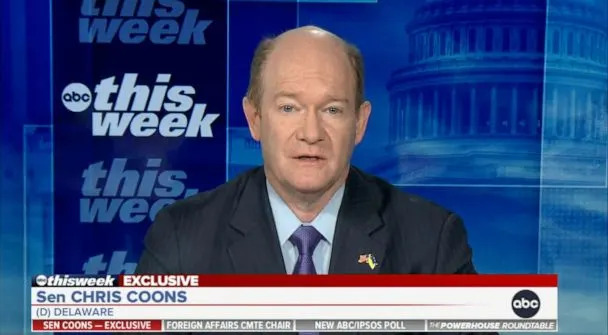
Sen. Coons says one key thing separates Biden, Trump docs cases — but acknowledges political ‘fallout’
Isabella Murray – January 22, 2023
Sen. Chris Coons, a close ally of Joe Biden, on Sunday insisted there was a key difference between the current president and former President Donald Trump’s handling of classified documents while out of office.
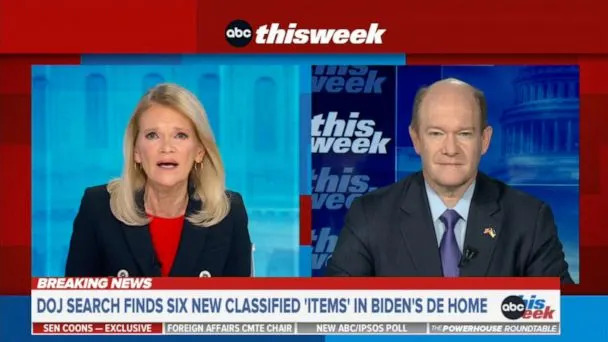
“I have some confidence that, because he is fully cooperating, we will get to the bottom of this,” Coons told ABC “This Week” co-anchor Martha Raddatz of Biden, in “sharp contrast” with Biden’s predecessor, whom the government suspects was less forthcoming in returning classified records.
On Saturday, Biden’s personal attorney said the Department of Justice had searched his Wilmington, Delaware, home the day before and found six items consisting of documents with classification markings, some from his time in the Senate in addition to his tenure as vice president.
The search was voluntary, according to federal authorities, and Biden’s attorney stressed his cooperation.
“There is one important document that distinguishes former President Trump from President Biden: That’s a warrant,” Coons, D-Del., said on “This Week.”
He was pressed by Raddatz over the latest developments and potential political consequences surrounding the discovery of multiple batches of documents with classified markings at an old office Biden used in Washington D.C. and at his Wilmington residence. This all unfolding just months after the Department of Justice separately recovered — via a court-authorized FBI search — a trove of classified materials from Trump’s Mar-a-Lago resort.
Coons contended that the controversy wasn’t “keeping Americans up at night,” but Raddatz pointed to a new ABC News/Ipsos poll showing 64% of people say Biden acted inappropriately in his handling of classified materials.
“You don’t think there will be any political fallout from this? You don’t think Americans look at this and say, ‘Look, they both had classified documents?'” Raddatz asked.
PHOTO: Sen. Chris Coons, D-Del., on “This Week.” (ABC News)
“I think the fallout is right now,” Coons said. “We’re talking about this, instead of President Biden’s leadership on confronting Russian aggression in Ukraine or talking about something I do think is on people’s minds — the potential of a debt ceiling fight and a default.”
“At a time when our president has done such a strong job, where we’ve got the wind at our back because of the big pieces of legislation that he just signed into law in the last few months, the fact that this will take up time and be a distraction — yes, that has a political impact,” Coons said.
But, he said, he didn’t think the controversy would become crucial for voters: “I do not think, in the end, Martha, that when we get to the next election, this will be the deciding issue.”
A first set of classified documents from Biden’s time as vice president was discovered at his old office by his personal attorneys just ahead of the 2022 midterm elections, though the discovery wasn’t revealed to the public until news reports in early January.
Biden’s attorneys have since said that more documents were found at his Wilmington residence in December and in January. On Jan. 12, Attorney General Merrick Garland announced he was naming a special counsel to handle the investigation.
On “This Week,” Raddatz repeatedly asked Coons on if he thought Biden had made a “mistake” in not publicly disclosing the matter before reporters did.
“I think we’ll let the public decide that and I think once we get to the end of the special counsel’s investigation, the American people will have a chance to make a judgment on that question,” Coons replied.
PHOTO: ABC News’ Martha Raddatz interviews Sen. Chris Coons, D-Del., on “This Week.” (ABC News)
While it remains unclear how the documents ended up at Biden’s office or his home in the years while he was out of office, Coons said Biden “had no idea. … I do think this was inadvertent. The whole point of having special counsel is to insure that and to give the American people confidence.”
Rep. Michael McCaul, R-Texas, took another view in his own “This Week” appearance. He said there were “a lot of unanswered questions” and criticized what he called a lack of transparency: “This broke a week before the midterm elections and they swept [it] under the rug.”
McCaul said the FBI search was “significant” and called both Biden and Trump “guilty of the same sin” in improperly retaining classified materials.
“Why are they taking these documents home? I don’t understand. I’ve lived in a classified world for a long time,” he said.
Coons, a Senate Foreign Relations Committee member who led the American congressional delegation in Davos, Switzerland, last week during the World Economic Forum, was also asked by Raddatz about the future of U.S. military aid for Ukraine to defend against Russia’s invasion. In Davos, German Chancellor Olaf Scholz reportedly told Coons and others that Germany would only send its advanced Leopard 2 battle tanks along with the U.S. sending M1 Abrams vehicles.
“I am concerned that Russia is re-arming and preparing for a spring offensive. If it requires our sending some Abrams tanks in order to unlock getting the Leopard tanks from Germany, from Poland, from other allies, I would support that,” Coons said on “This Week.”
Russia’s Wagner chief writes to White House over new U.S. sanctions
January 21, 2023
FILE PHOTO: Wagner private military group centre opens in St Petersburg
(Reuters) – The head of the Russian private military contractor Wagner published on Saturday a short letter to the White House asking what crime his company was accused of, after Washington announced new sanctions on the group.
White House national security spokesperson John Kirby said on Friday that Wagner, which has been supporting Russian forces in their invasion of Ukraine and claiming credit for battlefield advances, would be designated a significant Transnational Criminal Organization.
A letter in English addressed to Kirby and posted on the Telegram channel of Wagner founder Yevgeny Prigozhin’s press service read: “Dear Mr Kirby, Could you please clarify what crime was committed by PMC Wagner?”
Kirby called Wagner “a criminal organization that is committing widespread atrocities and human rights abuses”.
Last month, the White House said Wagner had taken delivery of an arms shipment from North Korea to help bolster Russian forces in Ukraine.
North Korea’s Foreign Ministry called the report groundless and Prigozhin at the time denied taking such a delivery, calling the report “gossip and speculation”.
Washington had already imposed curbs on trade with Wagner in 2017 and again in December in an attempt to restrict its access to weaponry.
The European Union imposed its own sanctions in December 2021 on Wagner, which has been active in Syria, Libya, the Central African Republic, Sudan, Mozambique and Mali, as well as Ukraine.
Prigozhin has described Wagner as a fully independent force with its own aircraft, tanks, rockets and artillery.
He is wanted in the United States for interference in U.S. elections, something that he said in November he had done and would continue to do.
(Writing by Kevin Liffey; Editing by Helen Popper)
Most damning of all, it features a never-heard-before audio recording made by one of Kavanaugh’s Yale colleagues—Partnership for Public Service president and CEO Max Stier—that not only corroborates Ramirez’s charges, but suggests that Kavanaugh violated another unnamed woman as well.
A last-minute addition to this year’s Sundance Film Festival, Justice is the first feature documentary helmed by Doug Liman, a director best known for Hollywood hits like Swingers, Go, The Bourne Identity, and Edge of Tomorrow. His latest is far removed from those fictional mainstream efforts, caustically censuring Kavanaugh and the political process that elevated him to the nation’s highest judicial bench, and casting a sympathetic eye on Ford, Ramirez ,and their fellow accusers.
Liman’s film may not deliver many new bombshells, but he and writer/producer Amy Herdy makes up for a relative dearth of explosive revelations by lucidly recounting this ugly chapter in recent American history, as well as by giving voice to women whose allegations were picked apart, mocked and, ultimately, ignored.
Win McNamee/Getty
The biggest eye-opener in Justice comes more than midway through its compact and efficient 85-minute runtime, when Liman receives a tip that leads him to an anonymous individual who provides a tape made by Stier shortly after the FBI—compelled by Ford’s courageous and heartrending testimony before the Senate Judiciary Committee—briefly reopened its investigation into embattled then-nominee Kavanaugh.
In it, Stier relays that he lived in the same Yale dorm as Kavanaugh and, one evening, wound up in a room where he saw a severely inebriated Kavanaugh with his pants down, at which point a group of rowdy soccer players forced a drunk female freshman to hold Kavanaugh’s penis. Stier states that he knows this tale “first-hand,” and that the young woman in question did not subsequently remember the incident, nor did she want to come forward after she’d seen the vile treatment that Ford and Ramirez were subjected to by the public, the media, and the government. The Daily Beast has reached out to Justice Kavanaugh for comment about the fresh allegations.
Stier goes on to explain that, though he didn’t know Ramirez, he had heard from classmates about her separate, eerily similar encounter with Kavanaugh, which she personally describes in Justice. According to Ramirez, an intoxicated Kavanaugh exposed himself right in front of her face in college, and that she suppressed memories of certain aspects of this trauma until she was contacted by The New Yorker’s Ronan Farrow.
As Ramirez narrates in a trembling tone that seems on the perpetual verge of cracking, she suffered this indignity quietly, convinced that she was to blame for it (because she too was under the influence) and humiliated by the guffaws of the other men in the room. Her account is convincing in its specificity, and moving in its anguish.
Ramirez confesses that some of Farrow’s questions made her worried that she still wasn’t recalling everything about that fateful night, and it’s Stier’s recording that appears to fill in a crucial blank. Stier says he was told that, after Kavanaugh stuck his naked member in Ramirez’s face, he went to the bathroom and was egged on by classmates to make himself erect; once he’d succeeded in that task, he returned to harass Ramirez some more.
It’s an additional bit of nastiness in a story drowning in grotesqueness, and Liman lays it all out with the sort of no-nonsense clarity that only amplifies one’s shock, revulsion and dismay—emotions that go hand-in-hand with outrage, which is stoked by the numerous clips of Kavanaugh refuting these accusations with unconvincing fury and falsehoods.
Erin Schaff-Pool/Getty
Through juxtapositions of Kavanaugh’s on-the-record statements and various pieces of evidence, Justice reveals the many lies advanced by the judge in order to both sway public opinion and to give Republicans enough reasonable-doubt cover to vote in favor of his confirmation.
Moreover, in a lengthy segment about text conversations between Kavanaugh’s college buddies and Ramirez’s Yale classmate Kerry Berchem, the film persuasively suggests that Kavanaugh and his team were aware of Ford and Ramirez’s charges before they became public, and sought to preemptively counter them by planting alternate-narrative seeds with friends and acquaintances.
While Liman relies a bit too heavily on graphical text to convey some of this, the idea that Kavanaugh (or those closest to him) conspired to keep his apparent crimes secret—along with his general reputation as a boozing party-hard menace—nonetheless comes through loud and clear.
Surprisingly, although Ford is seen speaking to Liman just off-camera at the beginning of Justice, she otherwise doesn’t appear except in archival footage. Still, her presence is ubiquitous throughout the documentary, which generates further anger by noting that the FBI ignored Stier’s tip, along with the majority of the 4,500 others they received regarding Kavanaugh. The Bureau instead chose to send along any “relevant” reports to the very Trump-administration White House that was committed to getting their nominee approved.
The effect is to paint the entire affair as a charade and a rigged game in which accusatory women were unfairly and maliciously put on the defensive, and powerful men were allowed to skate by on suspect evasions and flimsy denials.
Justice is more of a stinging, straightforward recap than a formally daring non-fiction work, but its direct approach allows its speakers to make their case with precision and passion. Of that group, Ramirez proves the memorable standout, her commentary as thorough and consistent as it is distressed.
In her remarks about Kavanaugh’s laughter as he perpetrated his misconduct—chortling that Ford also mentions to Congress—she provides an unforgettable detail that encapsulates the arrogant, entitled cruelty of her abuser, as well as the unjust system that saw fit to place him on the nation’s highest legal pedestal.
How an Investor Lost $625,000 and His Faith in George Santos
Grace Ashford, Alexandra Berzon and Michael Gold – January 20, 2023
As Rep. George Santos (R-N.Y.) was running for office, he also sought investors for a company that was accused of running a Ponzi scheme. (Tom Brenner/The New York Times)
A month after the Securities and Exchange Commission filed a lawsuit in 2021 accusing a Florida-based company of operating a Ponzi scheme, one of the firm’s account managers assured an anxious client that his money was safe.
The client, a wealthy investor named Andrew Intrater, had been lured by annual returns of 16% and had invested $625,000 in a fund offered by the company, Harbor City Capital — in part because he trusted and admired the account manager, an aspiring politician named George Santos.
Admiration aside, Intrater wanted to know about his investment and a promised letter of credit that secured it. Santos said that it was already on the way.
“All issued and sent over,” Santos assured him in a text message sent in May 2021.
The letter of credit did not exist, the SEC would later tell a court. The $100 million that Santos told Intrater that he had personally raised for Harbor City did not exist either, the commission said. Nor, seemingly, did the close to $4 million that Santos claimed he and his family had invested in Harbor City.
Santos’ representations form the basis of a sworn declaration that Intrater gave the SEC in May 2022, as part of its Harbor City investigation. Intrater’s interactions with the SEC are the first indication that the commission might be interested in Santos.
Intrater told the SEC that the representations influenced his decision to invest in Santos’ business and political endeavors — an allegation that could leave Santos vulnerable to criminal charges.
“I admired him and fundamentally I thought he’s a hardworking guy — he’s young and he has the ability to win,” Intrater said in a recent interview.
In late December, after Santos’ years of lies were exposed, Intrater reconsidered his appraisal. He shared with The New York Times text messages that he exchanged with Santos, as well as documents and the declaration that he had given to the SEC — all outlining the ways in which he said Santos had misled him.
“I don’t want Republicans having a bum representing Republicans, and I don’t want to have a guy that committed crimes walking free,” he said.
The SEC has not indicated publicly that it is looking into Santos and declined to answer questions about potential inquiries into the congressman or communications between Intrater and the agency. But the SEC reached out to Intrater in March 2022 to seek information on Santos’ dealings on behalf of Harbor City, according to Intrater and his lawyer.
Although Santos claimed to have raised $100 million for Harbor City, SEC documents say the firm had only raised a total of $17 million. And while Santos said that he and his family had invested millions of dollars because of Harbor City, financial disclosures filed during his 2020 run for Congress show that he earned just $55,000 that year, and had no assets.
If Santos had lured investors through the use of false statements, he could face charges of securities fraud, legal experts said.
It is not clear how the SEC is handling Intrater’s sworn declaration; it does not appear to have been filed in court. The SEC lawsuit against Harbor City and its chief executive, J.P. Maroney, was put on hold in October 2022 at the request of Maroney because of a related criminal investigation into him, court documents show. Maroney has denied wrongdoing.
Some of Santos’ interactions with Intrater have been outlined in news accounts, including in Mother Jones, The Daily Beast and The Washington Post.
But documents, as well as interviews and text messages reviewed by the Times, offer new evidence of the lengths Santos went to in an effort to obscure the problems at Harbor City, and how the relationship soured between the politician and one of his biggest supporters.
Intrater is a private equity investor perhaps best known for his financial ties to Viktor Vekselberg, his cousin. Vekselberg is a Russian oligarch whose U.S. assets were frozen in 2018 by the Treasury Department because of his ties to the Kremlin.
Under a license from the Treasury Department, Intrater says, he has continued to manage Vekselberg-connected assets but is in the process of winding them down. He says that he has not distributed or received funds or had business dealings with Vekselberg or related companies since the sanctions.
Intrater is also known for his relationship with Michael Cohen, Donald Trump’s onetime personal lawyer; Intrater’s firm, Columbus Nova, signed Cohen to a $1 million consulting contract when the businessman was looking for new investment opportunities in 2018.
Santos met Intrater a few years later; Intrater recalled that Santos called him seeking his financial support in the 2020 congressional race. After Santos lost, the two remained friendly, building a relationship over text messages and lunches at Osteria Delbianco, an Italian restaurant in midtown Manhattan. They bonded over a shared “old school” worldview and having families that fled the Holocaust, Intrater said. (Santos’ family did not actually flee the Holocaust, records show.)
Santos, as The Daily Beast reported, joined Harbor City in 2020, the same year he first ran for the House, and helped establish the firm’s presence in New York as its regional director. Santos had met Maroney, Harbor City’s CEO, when Santos was helping to organize conferences for LinkBridge Investors, Maroney said, and the two stayed in touch.
Maroney liked Santos, whom he described as “a consummate networker.” He hired him to bring in investments from the ultrawealthy.
According to court documents filed by the SEC, Harbor City told investors that it had discovered a way to make guaranteed money by investing in digital marketing and advertising.
But Harbor City was not doing any such investing, and only a small part of the $17 million it raised was used for legitimate business expenses, the government claims. The company, according to civil charges filed by the SEC, was instead engaged in a Ponzi scheme, using investments from new clients to make payments to older investors, while Maroney siphoned money from business accounts to buy a Mercedes and a waterfront house and pay down more than $1 million in credit card bills.
Intrater was a lucrative client. He decided to invest the $625,000 in a Harbor City fund, using a holding company, FEA Innovations. He and Maroney signed a subscription agreement, which was reviewed by the Times, on Jan. 15, 2021.
Intrater became one of Santos’ more generous patrons. In addition to his investments in Harbor City funds, first reported by The Washington Post, he donated more than $200,000 to Santos’ election campaign, associated political committees and a New York political action committee that he would later learn was controlled by Santos’ sister. He liked the political stances of Santos, a Republican, and his rags-to-riches story, he said.
In retrospect, he should have recognized warning signs, he said.
Though Intrater and his lawyers repeatedly requested the letter of credit, it never materialized. And while he received the first interest payment as scheduled in March 2021, the April payment was mysteriously clawed back. He did not receive any future payments from the company, he said.
With the April payment and the bank letter still missing, Intrater followed up with Santos on May 28, 2021. Intrater said he was unaware at the time that the SEC had by then made public its fraud complaint against Maroney and Harbor City.
But all was well, Santos assured Intrater, casually mentioning that he had been let go a few weeks earlier. Santos, who was running for Congress a second time, told Intrater that his political activities were deemed to be a conflict for Harbor City and he was leaving to focus on his real estate and small projects. (Santos has since admitted that he does not own any property.)
Maroney said in an interview that he had no problems with Santos’ political career and that he supported his ambitions, even agreeing to hold a fundraiser for Trump’s reelection bid at his home.
In fact, Maroney and another former Harbor City employee said Santos had been with the firm until the end. Maroney recalled in an interview last month that Santos “was definitely one of the ones that got the notice that everything we had had been frozen.”
Yet months after Harbor City’s accounts were frozen in April, Santos was still telling Intrater that things were fine, maintaining that the $100 million fund he had mentioned was separate from the one described in the SEC case, according to text messages he sent Intrater.
“Hey Andy, I put in calls to everyone I know still working at HC,” he wrote Intrater. “Should hear back today I hope.”
A few days later, Santos was fretting about his own financial exposure, which he had told Intrater was huge. “I’m having a nervous breakdown,” he texted.
As late as January 2022 he swore to Intrater that his family had invested “almost 4M,” and said that he had employed a lawyer, Joe Murray, to help him try to claw back any remaining funds.
The court-appointed lawyer overseeing Harbor City’s assets, Katherine Donlon, would not formally say whether Santos and his family had invested in Harbor City. But she said that she did not recognize their names as investors, in response to a request emailed by the Times.
Murray declined to answer questions from the Times about Santos’ representations to Intrater and on behalf of Harbor City, saying only, “It would be inappropriate to comment on an ongoing investigation.” Santos, who was not named in the SEC suit, has publicly said he had no knowledge of wrongdoing at Harbor City, an assertion that Maroney backed up.
Intrater said that at the time, he felt for the younger man, who he believed was also a victim.
“Take long walks to clear your head in order to deal with the stress,” he coached Santos via text, urging him to avoid stress eating and alcohol.
The two stayed in touch, even as Intrater came to write off his investment. When Santos appealed to him again for political donations in his second run for Congress, Intrater came through, donating tens of thousands of dollars to Santos’ associated PACs.
And he remained receptive to business opportunities presented by Santos, who helped to set up at least two other potential deals. Neither came together.
Neither Intrater nor his lawyer have heard much from the SEC since filing the declaration, they said, with the commission only replying in November 2022 to say that the civil case had been stayed.
By then, Santos had been elected to represent New York’s 3rd Congressional District. A few days later, Intrater had lunch with the congressman-elect and offered his congratulations.
Things changed in December after Santos’ deception became public. In the weeks since, Intrater said he has reached out to the Department of Justice offering information on Santos. The agency declined to comment.
The last time the men spoke, Intrater says, was after he saw Santos being grilled on Fox News, about a week after the Times ran its initial investigation.
“I said, ‘Dude, I saw your interview,’” Intrater said. “‘You look like you’re absolutely lying about everything.’”
Once again, Santos sought to reassure him. But Intrater was no longer interested in explanations.
He told Santos that he was convinced he was a liar and then cursed at him, he said. “I hung up the phone,” he added. “That was it.”
Russia’s relationship with U.S. at its ‘lowest historical point,’ Kremlin says
Niamh Cavanagh, Reporter – January 20, 2023
Kremlin spokesman Dmitry Peskov at a news conference in Moscow in December. (Sputnik/Valeriy Sharifulin/Pool via Reuters)
LONDON — The Kremlin said Friday that Russia’s relationship with the U.S. is at an all-time low.
Speaking to reporters, Kremlin spokesman Dmitry Peskov said that despite timid hopes from the Geneva summit in 2021, bilateral relations were “at their lowest historical point.” He added, “There is no hope for improvement in the foreseeable future.”
The comments follow months of what has come to be a total breakdown in relations between the two powers. Relations went from bad to worse when after conducting several military drills along Ukraine’s border, Russia’s forces launched what it called a “special military operation” on Feb. 24, 2022. The invasion was met with immediate and harsh sanctions from the U.S. as well as Ukraine’s Western allies.
All hopes for any progress in relations were slashed when the Biden administration threw its full support behind Russia’s neighboring countries Finland and Sweden in joining NATO.
President Biden departs Hartsfield-Jackson Atlanta International Airport on Sunday. (Brendan Smialowski/AFP via Getty Images)
This, according to reports, meant the U.S. would be going against its agreement with Russia in 1991 that NATO would not expand past East Germany. This part of the agreement has been hotly contested, as there had been no legal binding between the two nations that would prohibit countries in Eastern Europe from joining the military alliance.
Over the past 11 months, the Biden administration has made several announcements that the U.S. would be providing Ukraine with billions of dollars in military aid and assistance. With Russia’s recent onslaught of airstrikes on Ukraine, the U.S. and other allies have announced plans to provide the beleaguered nation’s military with more weapons.
On Friday, Peskov told reporters that the wave of assistance from the West would be met with consequences.
“We see a growing indirect and sometimes direct involvement of NATO countries in this conflict,” he said. “We see a devotion to the dramatic delusion that Ukraine can succeed on the battlefield. This is a dramatic delusion of the Western community that will more than once be cause for regret, we are sure of that.”
His remarks came as Western defense ministers gathered at an air base in Germany to discuss supplying further military assistance to Ukraine.