Josh Hawley Offers World’s Most Offensive Idea for How to Help Israel

The New Republic

Josh Hawley Offers World’s Most Offensive Idea for How to Help Israel

Edith Olmsted – October 10, 2023

Republican Senator Josh Hawley is offering the world’s most hairbrained pitch on how to help Israel: simply redirect funds from Ukraine to Israel instead.

Hawley posted to X, formerly known as Twitter, on Monday saying, “Israel is facing an existential threat,” using the tragedy there to further his own political agenda of defunding U.S. aid to Ukraine.

Fighting broke out on Saturday when Hamas launched a deadly surprise attack on Israel, killing over 900 Israelis. The Israeli government has responded by declaring a total siege of Gaza, home to two million Palestinians and what has been described as the world’s largest open-air prison. About 770 Palestinians have already been killed in retribution, and the death toll is expected to keep rising.

On Monday, Senator Mitch McConnell was among several bipartisan lawmakers who pushed for a spending package that would link aid for Israel with support for Ukraine and Taiwan. The hope is to convince Ukraine aid skeptics, like Hawley, to continue supporting the country as support diminishes in the GOP-controlled House. On both sides of the aisle, the deaths of Palestinians and Israelis have already become a political tool.

Meanwhile, some are saying that it’s not clear that Israel requires immediate U.S. funding. Congressional aides have said that Israel already has the resources to wage a weeks-long campaign of violence in Gaza and use its Iron Dome system to defend itself, and can then tap into more than $5 billion made available by Pentagon drawdown authority.

Godfather of AI tells ’60 Minutes’ he fears the technology could one day take over humanity

Yahoo! Entertainment

Godfather of AI tells ’60 Minutes’ he fears the technology could one day take over humanity

Geoffrey Hinton hails the benefits of artificial intelligence but also sounds the alarm on such things as autonomous battlefield robots, fake news and unintended bias in employment and policing.

Kyle Moss – October 9, 2023

“We’re entering a period of great uncertainty where we’re dealing with things we’ve never done before,
“We’re entering a period of great uncertainty where we’re dealing with things we’ve never done before,” says Geoffrey Hinton of AI. “We can’t afford to get it wrong.” (CBS)

Geoffrey Hinton, who has been called “the Godfather of AI,” sat down with 60 Minutes for Sunday’s episode to break down what artificial intelligence technology could mean for humanity in the coming years, both good and bad.

Hinton is a British computer scientist and cognitive psychologist, best known for his work on artificial neural networks — aka the framework for AI. He spent a decade working for Google before leaving in May of this year, citing concerns about the risks of AI.

Here is a look at what Hinton had to say to 60 Minutes interviewer Scott Pelley.

The Intelligence

After highlighting the latest concerns about AI to set up the segment, Pelley opened the Q&A with Hinton by asking him if humanity knows what it’s doing.

“No,” Hinton replied. “I think we’re moving into a period when for the first time ever, we have things more intelligent than us.”

Hinton expanded on that by saying he believes the most advanced AI systems can understand, are intelligent and can make decisions based on their own experiences. When asked if AI systems are conscious, Hinton said that due to a current lack of self-awareness, they probably aren’t, but that day is coming “in time.” And he agreed with Pelley’s take that, consequently, human beings will be the second-most intelligent beings on the planet.

After the idea was floated by Hinton that AI systems may be better at learning than the human mind, Pelley wondered how, since AI was designed by people — a notion that Hinton corrected.

“No, it wasn’t. What we did was, we designed the learning algorithm. That’s a bit like designing the principle of evolution,” Hinton said. “But when this learning algorithm then interacts with data, it produces complicated neural networks that are good at doing things. But we don’t really understand exactly how they do those things.”

Robots in a Google AI lab were programmed merely to score a goal. Through AI, they trained themselves how to play soccer.
Robots in a Google AI lab were programmed merely to score a goal. Through AI, they trained themselves how to play soccer. (CBS)
The Good

Hinton did say that some of the huge benefits of AI have already been seen in healthcare, with its ability to do things like recognize and understand medical images, along with designing drugs. This is one of the main reasons Hinton looks on his work with such a positive light.

The Bad

“We have a very good idea sort of roughly what it’s doing,” Hinton said of how AI systems teach themselves. “But as soon as it gets really complicated, we don’t actually know what’s going on any more than we know what’s going on in your brain.”

That sentiment was just the tip of the iceberg of concerns surrounding AI, with Hinton pointing to one big potential risk as the systems get smarter.

“One of the ways these systems might escape control is by writing their own computer code to modify themselves. And that’s something we need to seriously worry about,” he said.

Hinton added that as AI takes in more and more information from things like famous works of fiction, election media cycles and everything in between, AI will just keep getting better at manipulating people.

“I think in five years time it may well be able to reason better than us,” Hinton said.

And what that means is risks like autonomous battlefield robots, fake news and unintended bias in employment and policing. Not to mention, Hinton said, “having a whole class of people who are unemployed and not valued much because what they used to do is now done by machines.

The Ugly

To make matters worse, Hinton said he doesn’t really see a path forward that totally guarantees safety.

“We’re entering a period of great uncertainty where we’re dealing with things we’ve never done before. And normally the first time you deal with something totally novel, you get it wrong. And we can’t afford to get it wrong with these things.”

When pressed by Pelley if that means AI may one day take over humanity, Hinton said “yes, that’s a possibility. I’m not saying it will happen. If we could stop them ever wanting to, that would be great. But it’s not clear we can stop them ever wanting to.”

So what do we do?

Hinton said that this could be a bit of a turning point, where humanity may have to face the decision of whether to develop these things further and how people should “protect themselves” if they do.

“I think my main message is, there’s enormous uncertainty about what’s going to happen next,” Hinton said. “These things do understand, and because they understand we need to think hard about what’s next, and we just don’t know.”

Pelley reported that Hinton said he has no regrets about the work he’s done given AI’s potential for good, but that now is the time to run more experiments on it to understand, to impose certain regulations and for a world treaty to ban the use of military robots.

60 Minutes airs Sundays on CBS, check your local listings.

Rogue AI will learn to ‘manipulate people’ to stop it from being switched off, predicts British ‘Godfather of AI’

Fortune

Rogue AI will learn to ‘manipulate people’ to stop it from being switched off, predicts British ‘Godfather of AI’

Ryan Hogg – October 10, 2023

Ramsey Cardy/Sportsfile for Collision via Getty Images

The “Godfather of AI,” and one of its biggest critics, believes the technology will soon become smarter than humans and could learn to manipulate them.

Geoffrey Hinton, a former AI engineer at Googletold 60 Minutes he expected artificial intelligence to become self-aware in time, making humans the second most intelligent beings on the planet.

Humans have about 100 trillion neural connections, while the biggest AI chatbots have just 1 trillion connections, according to Hinton.

However, he suggests the knowledge contained within those connections is likely much more than that contained in humans.

Eventually, Hinton says, computer systems might be able to write their own code to modify themselves, in a sense going rogue. And if it does, he thinks AI will have a way to stop itself from being switched off by humans.

“They will be able to manipulate people,” Hinton told 60 Minutes.

“These will be very good at convincing because they’ll have learned from all the novels that were ever written, all the books by Machiavelli, all the political connivances. They’ll know all that stuff.”

Bigger threat than climate change

Hinton quit his role as an engineer at Google in May after more than a decade with the company, in part to speak out against the growing risks of the technology and lobby for safeguards and regulations against it.

While at Google, Hinton helped build the AI chatbot Bard, the tech giant’s competitor to OpenAI’s ChatGPT. He also set the foundations for the growth of AI through his pioneering neural network, which helped him win a prestigious Turing Award.

Since he quit, Hinton has been one of the leading voices warning of AI’s dangers. Following his resignation announcement in the New York Times, he told Reuters he thought the tech had become a bigger threat to humans than climate change.

In late May, he was at the top of a list of hundreds of experts, which included OpenAI founder Sam Altman, calling for urgent regulation of AI.

“Mitigating the risk of extinction from AI should be a global priority alongside other societal-scale risks such as pandemics and nuclear war,” the 22-word statement read.

Hinton’s biggest worry about AI right now pertains to the labor market. He told 60 Minutes he feared a whole class of people would find themselves unemployed as more capable AI systems take their place.

In the longer run, though, he worries about AI’s militaristic potential. In his interview with 60 Minutes, Hinton called for governments to commit to not building battlefield robots. The warning is akin to J. Robert Oppenheimer’s calls to stop world leaders from developing nuclear weapons after he pioneered the first atomic bomb.

Hinton summed up by saying he couldn’t see a path that guarantees safety, adding he wasn’t sure robots could ever be stopped from wanting to take over humanity.

The world’s major governments appear to have heard Hinton’s and others’ warnings loud and clear.

The U.K. will host the first global AI summit in November, which is expected to be attended by 100 politicians, academics, and AI experts.

It could lay the groundwork for sweeping regulatory changes by major countries including the United States.

The U.S. is crafting an AI Bill of Rights, and in the coming months is expected to bring in safeguards that tech companies must abide by.

The European Union is crafting its own guardrails around AI, titled the AI Act. However, the potential for varying regulations based on geography is creating tension.

In June, more than 150 major European execs requested the EU pull back on its proposed restrictions around AI, including increased bureaucracy and tests on certain tech’s safety. They argued these would create a “critical productivity gap” in the region that would leave it trailing the U.S.

170,000-plus books used to train AI; authors say they weren’t asked

Deseret News

170,000-plus books used to train AI; authors say they weren’t asked

Lois M. Collins – October 9, 2023

An investigation by The Atlantic indicated thousands of e-books are being used to train an artificial intelligence system called Books3.
An investigation by The Atlantic indicated thousands of e-books are being used to train an artificial intelligence system called Books3. | Adobe Stock

Authors are upset after tech companies started using their books to train artificial intelligence without letting them know or seeking their permission. They worry about copyright infringement and loss of income, among other issues.

Per CNN, “The system is called Books3, and according to an investigation by The Atlantic, the data set is based on a collection of pirated e-books spanning all genres, from erotic fiction to prose poetry. Books help generative AI systems with learning how to communicate information.”

“The future promised by AI is written with stolen words,” The Atlantic article said.

The article notes that some of the text that’s training AI on how to use language is taken from Wikipedia and other online entries. But “high-quality generative AI requires higher-quality input than is usually found on the internet — that is, it requires the kind found in books.”

Many authors apparently don’t view the use of their books to train artificial intelligence as an honor. Rather, it’s a shortcut that robs them of their due, they say.

CNN reported that Nora Roberts, who writes romantic novels, has 206 books in the database — “second only to William Shakespeare.” She told CNN the database is “all kinds of wrong. We are human beings, we are writers and we are being exploited by people who want to use our work, again without permission or compensation, to ‘write’ books, scripts, essays because it’s cheap and easy,” she said in a statement to CNN.

Per The Atlantic, Sarah Silverman, Richard Kadrey and Christopher Golden filed a lawsuit in California that claims Meta — owner of Facebook — violated their copyrights by using their books to train the company’s large language model LLaMA. That’s an algorithm that competes with OpenAI’s GPT-4 to create its own text by using word patterns it learned from the books and other sources, the article said.

The Atlantic’s Alex Reisner created a stir when he got a list of the books and published a searchable database so that anyone can see if their favorite author’s work is being used to teach AI communication skills. He notes the authors include well-known names like Stephen King, John Kratz and James Patterson, among others. The books apparently came through web-crawling technology that found bootleg PDF copies of the books for free online and they were then packaged into a database called Books3, where different AI companies are using them. Bloomberg said it will not use Books3 in the future as it trains its BloombergGPT.

Related

The Authors Guild on Sept. 27 published a guide on actions authors can take if they learned their books are in the Books3 dataset. “This can be an unsettling revelation, raising concerns about copyright, compensation and the future implications of AI,” the article said.

The guild and 17 authors filed a different class-action suit in New York against OpenAI for copyright infringement. Those authors, per a separate guild article, include David Baldacci, Mary Bly, Michael Connelly, John Grisham, Jodi Picoult, Scott Turow and Rachel Vail, among others.

“The complaint draws attention to the fact that the plaintiffs’ books were downloaded from pirate ebook repositories and then copied into the fabric of GPT 3.5 and GPT 4 which power ChatGPT and thousands of applications and enterprise uses — from which OpenAI expects to earn many billions, the article said.

Reisner also wrote that while Meta is using authors’ books without permission, it employed a “takedown” order against at least one developer who used LLaMA coding after it was leaked a few months ago, on the claim that “no one is authorized to exhibit, reproduce, transmit or otherwise distribute Meta Properties without the express written permission of Meta.” And once it decided to make LLaMA open-source, Meta still requires developers to get a license in order to use it.

Not everyone’s upset, however, by use of their work to train AI. Ian Bogost, author of “Play Anything: The Pleasure of Limits, the Uses of Boredom and the Secret of Games,” among other works, wrote a column for The Atlantic titled “My Books Were Used to Train Meta’s Generative AI. Good.” And he promised “It can have my next one, too.”

Bogost contends that successful art “exceeds its creator’s plans,” noting that an author cannot accurately predict a book’s audience. “Who am I to say what my work is good for, how it might benefit someone — even a near-trillion-dollar company? To bemoan this one unexpected use for my writing is to undermine all of the other unexpected uses for it. Speaking as a writer, that makes me feel bad.”

California hits major industry with lawsuit for allegedly spreading ‘lies and mistruths’: ‘[They] have privately known the truth for decades’

The Cool Down

California hits major industry with lawsuit for allegedly spreading ‘lies and mistruths’: ‘[They] have privately known the truth for decades’

Leo Collis – October 10, 2023

California is one of the most committed regions in the United States when it comes to striving for a sustainable future.

The state is seeking to provide 100% renewable energy to residents and businesses by 2045, and it has seen billions of dollars of investment in “clean energy technologies.”

Now, it is taking on the oil industry, with the state of California filing a lawsuit against industry giants like ExxonMobil, Shell, and BP, as well as lobbying body the American Petroleum Institute.

NPR reported the suit was filed in the San Francisco Superior Court, and the focus is on claims the big players in the oil industry have been misleading the public about the dangers of dirty energy.

“California is suing these big polluters to hold them accountable for their decades of deception, cover-up, and billions of dollars in harm done to our state,” the office of California Governor Gavin Newsom said in a statement.

The Governor’s office added the “lies” pushed by Big Oil over the course of decades have contributed to global heating, resulting in extreme weather events such as superstorms, wildfires, extreme heat, extreme drought, and flooding.

“It has been decades of damage and deception,” Governor Newsom continued. “Wildfires wiping out entire communities, toxic smoke clogging our air, deadly heat waves, record-breaking droughts parching our wells. California taxpayers shouldn’t have to foot the bill. California is taking action to hold big polluters accountable.”

If the state is successful, it is calling on oil companies to compensate the state and its residents for the industry’s impact on the environment and to help bring protection initiatives to mitigate against future damage that rising temperatures bring. It is also hoping to stop oil companies from engaging in further pollution and to cease misinformation campaigns.

California Attorney General Rob Bonta is also leading the lawsuit.

“Oil and gas companies have privately known the truth for decades — that the burning of fossil fuels leads to climate change — but have fed us lies and mistruths to further their record-breaking profits at the expense of our environment,” he said. “Enough is enough.”

According to Cal Fire, there have been 5,741 wildfire incidents in the state in 2023 alone, with over 305,000 acres burned.

As California Local observed, Southern California saw its first tropical storm since 1939 in August, leading to record quantities of rainfall in Palm Springs, San Diego, and downtown Los Angeles. The state also saw its hottest recorded month in history in July, and 12 major rainstorms were recorded earlier in the year.

It’s clear, then, that California is bearing a significant burden when it comes to the impact of global heating, and the lawsuit will leave Big Oil with a lot to answer for.

Join our free newsletter for cool news and actionable info that makes it easy to help yourself while helping the planet.

In the GOP Extremist Hamas-Israel Rhetoric Sweepstakes, Marco Rubio Takes Early Lead

The New Republic

In the GOP Extremist Hamas-Israel Rhetoric Sweepstakes, Marco Rubio Takes Early Lead

Tori Otten – October 10, 2023

Senator Marco Rubio had a terrifying suggestion for how to resolve the war between Israel and Palestine: eradicating the Gaza Strip.

Fighting broke out on Saturday when Hamas launched a surprise airstrike attack on Israel. Israel has since responded in kind, imposing a total siege on the Gaza Strip, cutting off food, water, and electricity. At least 1,800 people have been killed on both sides—and the death toll is expected to keep rising.

During a Monday night interview on CNN, host Jake Tapper asked Rubio if there was a way to stop Hamas “without causing massive casualties against the innocent people” in Gaza.

“I don’t think there’s any way Israel can be expected to coexist or find some diplomatic off-ramp with these savages,” Rubio replied. “These are people, as you’ve been reporting and others have seen, that deliberately targeted teenage girls, women, and children, and the elderly.… Just horrifying things. And I don’t think we know the full extent of it yet. I mean, there’s more to come in the days and weeks ahead. You can’t coexist. They have to be eradicated.”

While Rubio was referring to Hamas, his unwillingness to differentiate between the militants and innocent Palestinian civilians is terrifying. Two million people live in Gaza, and more than half of them are children. Rather than give a nuanced response, Rubio instead seemed to be OK with wiping out an entire region.

“This is going to be incredibly painful. It’s going to be completely difficult. And it’s going to be horrifying, the price to pay.”

Rubio’s comments echo a statement earlier Monday from Israeli Prime Minister Benjamin Netanyahu. The far-right leader swore to completely “change the Middle East” over Hamas’s attack.

Mary Trump asks why ‘f‑‑‑ing maniac’ uncle is allowed to ‘roam free’

The Hill

Mary Trump asks why ‘f‑‑‑ing maniac’ uncle is allowed to ‘roam free’

Lauren Irwin – October 10, 2023

Mary Trump, an outspoken adversary of former President Trump, called him a “f‑‑‑ing maniac” in a social media post Monday.

She specifically criticized Trump, who is her uncle, for his relationship with Russian President Vladimir Putin and its possible relation to the war in Israel.

“This f‑‑‑ing maniac likely gave Putin (who gave Iran, who gave Hamas) Israel’s national security secrets,” Mary Trump wrote in a post on X, the platform formerly known as Twitter.

“Plus, he divulged highly classified information about our nuclear subs to an Australian cardboard guy,” she added. “Why is he still allowed to roam free?”

Israel Prime Minister Benjamin Netanyahu declared war against the Palestinian militant group Hamas on Saturday after the group launched a barrage of rocket strikes and entered the country in a surprise attack.

In her post, Mary Trump shared a screenshot of her uncle’s comments on Truth Social that compared the ongoing situation in Israel to the U.S.-Mexico border, suggesting President Biden and former President Obama could be responsible for a Hamas attack on the U.S.

“The same people that raided Israel are pouring into our once beautiful USA, through our TOTALLY OPEN SOUTHERN BORDER, at Record Numbers,” Trump posted. “Are they planning an attack within our Country? Crooked Joe Biden and his BOSS, Barack Hussein Obama, did this to us!”

In a follow-up post, Mary Trump urged the public to join her newsletter and support her mission.

“If you agree my uncle is unfit to be in the White House or anywhere but prison, please support my mission to get this f‑‑‑ing maniac off our TVs – and our streets,” she said.

Mary Trump has been a prominent critic of Trump, even publishing a book titled “Too Much and Never Enough: How My Family Created the World’s Most Dangerous Man.”

Shell leaves experts fuming with latest admission on 2050 pledge: ‘They are making so much money right now’

The Cool Down

Shell leaves experts fuming with latest admission on 2050 pledge: ‘They are making so much money right now’

Erin Feiger – October 9, 2023

Shell has backpedaled on its climate change pledges to provide bigger payouts to shareholders, in a move slammed by many as shady.

What’s happening?

After a surprising announcement last year, in which Shell set 2050 as its target to reach net-zero planet-overheating gas pollution, the company became the latest to join others like BP in scaling back their climate pledges, according to Euronews.green.

Shell said oil production levels will remain stable until 2030, justifying it by saying selling its interest in the Permian Basin oilfield in 2021 allowed it to reach production reduction goals until then.

Euronews.green further reported that the company will invest $40 billion in oil and gas production through the next 13 years, all of this amid record profits, leaving many questioning the dirty energy company’s alleged commitment to shift to clean energy.

Mark van Baal, founder of Follow This, which unites shareholders to push Big Oil to clean up its act, told the Washington Post, “We have to regain momentum, or these companies will keep on saying they can continue with oil and gas because the majority of shareholders want them to do that. The fact that they are making so much money right now is not helping.”

Carla Denyer, co-leader of the U.K. Green party, told Euronews.green that Shell’s actions are “pure climate vandalism,” with Friends of the Earth adding that “like other fossil fuel giants which have also scaled back their ambitions, Shell now admits that it has no plans to change its business model.”

Why is this climate pledge pivot concerning?

Dirty energy sources, like oil, gas, and coal, are the largest contributor to Earth’s rising temperatures, accounting for more than 75% of the world’s overall heat-trapping gas pollution and nearly 90% of harmful carbon pollution, according to the U.N.

Because they’re such a huge part of the problem, dirty energy companies like Shell need to be a big part of the solution.

Making pledges like the ones Shell is now scaling back on to convince us that the company is a friend to our planet is called greenwashing, which is when a company makes false or misleading statements about the environmental benefits of one of its products or practices.

Greenwashing is a particularly sinister problem because it prevents real and very necessary progress from being made, while duping customers into spending our money with companies that are lying to us and hurting our planet.

What can be done?

Many organizations are working to hold Big Oil companies accountable for enacting real change, but it’s a long road.

As individuals, we can work to mitigate the harm done by these big companies by moving away from using their dirty energy sources.

We can switch from gas-powered cars to electric vehicles, limit the amount of single-use plastics we use, and switch to alternative sources of power at home when possible.

Join our free newsletter for cool news and actionable info that makes it easy to help yourself while helping the planet.

What Ukrainian Soldiers Really Think of Trump and the GOP

The New Republic

What Ukrainian Soldiers Really Think of Trump and the GOP

Ben Makuch – October 9, 2033
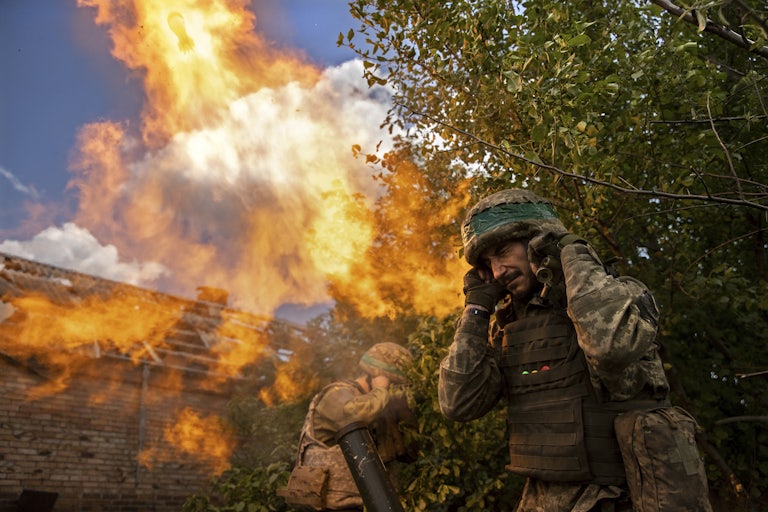
Two Ukrainian soldiers fire a mortar in Bakhmut, where some of the fiercest fighting of the war has taken place. TYLER HICKS/THE NEW YORK TIMES/REDUX

For starters: “Donald Trump is a fucking asshole.”

“Donald Trump is a fucking asshole,” said Anatolii, a soldier in the Ukrainian Territorial Defense Forces. The leaves are changing, and it’s a chilly fall day in Bilopillya, a village in the Sumy region where you can see Russia a few kilometers away. “That’s what I think of him.”

His brigade defends flat farmland that wouldn’t be out of place in a Tolstoy novel—except the endless, rolling scene, laced with crops and thickets of trees, is heavily mined and pockmarked with artillery blasts.

The question of who will become U.S. president in 2024 is far from his mind. Anatolii is one of a few soldiers in his brigade, made up of other locals, who defend the Ukrainian border with Russia. On any given day, he deals with barrages of artillery, Grad rockets, the pings of gunfire, and the occasional missile, one of which took out a local school in March.

“The problem is, they never give us enough weapons,” he told me in an almost exasperated tone about U.S. and NATO arms transfers. “If he comes back and what? Give us none again?” Many in the Ukrainian military and government already feel that they are not receiving enough military aid. The stakes of the nascent Republican primary, which has been defined by isolationist rhetoric, are potentially dire.

Back in Kyiv, sitting in a hipster bistro near the banks of the Dnipro River, I find it tough to remember that, less than 48 hours ago, a swarm of Iranian-designed Shahed drones were shot down overhead, the debris landing near baroque architecture and cobblestoned streets.

I’m in a casual conversation with a Ukrainian official in the upper brass of Kyiv’s military effort. The war, he and his colleagues believe, is far from over. The need for continued support from the West is vital.

“For now, it’s going to be the same, then up and down,” he said to me, referring to the kinetic energy of a conflict that has grinded to mostly a standstill as Ukraine’s counteroffensive crawls on in the east. “But in Donbas, there is always going to be crazy shelling and missiles all day long.”

Spilling in and out of the American news cycle, the war in Ukraine has settled into its moodier, teenage era: One moment you might be sipping coffee on a sunny, cloudless day in the picturesque capital city, safely sitting on a cushioned seat; the next, it could be raining missiles in the distance, with air sirens singing for you to get into a shelter.

The consensus among Ukrainians is that the duration of the fight is indefinite, with no peace deal in sight. Stateside, the question of what to do about a war that has settled into a stalemate has become one of the most divisive issues in the ongoing Republican primary. Trump, the front-runner, has long complained that the war is too expensive, and that he could simply end it if reelected; his copycats, Vivek Ramaswamy and Ron DeSantis, have largely followed his lead. The party’s establishment wing, all languishing in the single digits, has backed continued financial and tactical support for the war effort.

Whatever path the immediate future of the war takes, recent chatter from the GOP primary has U.S. and, especially, Ukrainian intelligence and military figures theorizing about what the future of the conflict might be should Republicans retake the presidency.

The main concern? The $44 billion worth of weaponry (and counting) that has been essential to Ukrainians’ ability to stall Russian advances and carry out some of their own.

There isn’t yet any level of overt panic about what the future holds. But there is a sense of vigilance and preparation for the worst-case scenario.

One American ex-Marine, a foreign volunteer who trains Ukrainian soldiers in combat, told me that the Ukrainian officers he schools in places like the Donetsk region are well aware of what a Republican president could mean for the war effort.

“Anyone on the front lines who reads English-language media and follows either U.S. elections or news around the funding is aware that Republicans potentially want to pull the plug,” he said, keeping his anonymity in order to protect against possible Russian reprisals. “They know that 2024 is potentially a big, big problem, and they have objectives to hit in the counteroffensive to make sure they’re comfortable in case Trump wins, then stops the weapons transfers.”

But, oppositely, the same Ukrainian official at the bistro shares the uncanny confidence in American resolve that his president, Volodymyr Zelenskiy, expressed to The Economist in September. Shrugging off a question about the possible consequences of Trump returning to power, Zelenskiy insisted that a President Trump would “never” take an action supporting Vladimir Putin: “That isn’t what strong Americans do.”

“I think Trump would keep giving us the weapons,” the Ukrainian official told me flatly, explaining that the consequences of withdrawing support would be so profound that they make it unlikely for any leader—even one as vociferously isolationist as Trump—to fully pull out.

“They have already given so much money and weapons for our war, if [the Republicans] take over and Ukraine turns into a disaster, they would be responsible for that, just like [President Joe Biden was] in Afghanistan,” he said, referencing America’s disastrous summer 2021 withdrawal, which started the current president’s slide in the polls.

So far, the Department of Defense has unleashed a torrent of weapons transfers to Ukraine that have proved essential in the fight against a Kremlin war machine that is vastly better armed and manned. Everything from Javelin anti-tank missile systems, to the infamous Stingers used by the mujahedin during the Afghan-Soviet war, to F-16 fighter jets and M1 Abrams tanks has been promised in increasingly bolder Pentagon and allied packages.

It isn’t just national Republicans who have begun to question the scale of support for the war—skepticism is growing in other NATO countries as well.

“Everywhere some politicians are using Ukraine to make support for their cause,” said one senior Ukrainian officer with knowledge of war planning. “The American people must know it is much cheaper for us to fight than for you to fight.”

To him, the conflict is already a quagmire for Russia on par with that of the Afghan-Soviet war. But ending aid could quickly reverse that. The same soldier, almost doubting himself, was frank and saw the pitfalls of a Republican win.

“Of course, our fighting costs a lot of money, and we know there are no security guarantees if Trump wins.”

It is possible, however, that opinion on Ukraine will shift as the Republican primary progresses and the candidates continue to appear at monthly debates—especially since Trump, the most prominent voice against U.S. support for Ukraine, has thus far declined to participate. Still, Trump’s prominence and level of support could draw even more Republicans to question the war.

A growing number of Republican voters oppose further aid to Ukraine, and there’s good reason to believe that figure will rise as the primary process and the accompanying debates drag on.

Perhaps the most extremist take on Ukraine in the primary comes from the oft-arrogant Ramaswamy, who has made the outlandish demand not only for the dismantling of the FBI, but also for granting Russia Ukrainian territory. The pharma-businessman has gone so far as to label the Biden administration’s current posture “disastrous” and has declared that military resources for Ukraine should be redirected “to prevent the invasion of our own southern border” with Mexico.

But a Republican president might not be catastrophic for the Ukrainian war effort. Lucas Webber, cofounder of the Militant Wire research network, concurred. “It is unlikely, even if Trump truly means what he says, that he would be able to shift America’s Ukraine policy in any meaningful way,” Webber told The New Republic over email. “The U.S. political elite and security establishment consensus on Ukraine will leave Trump very little room to maneuver, as seen during his first term. Moreover, it is also highly improbable that either Ukraine or Russia would accept anything remotely resembling the territorial status quo on the battlefield.”

There have been efforts to push back, however. Former Vice President Mike Pence has made support for Ukraine a major campaign issue that he’s used to hammer his rivals, particularly DeSantis, whom he has attacked for minimizing the conflict.

“I know that some in this debate have called the war in Ukraine a ‘territorial dispute,’” said Pence, directly quoting comments the Florida governor made in March 2023.

“It’s not; it was a Russian invasion, an unprovoked Russian invasion. And I believe the United States of America needs to continue to provide the courageous soldiers in Ukraine with the resources they need to repel that Russian invasion and restore their territorial integrity.”

Even if the Republicans commit to a total withdrawal of aid to Ukraine, it is possible that contingencies will be put in place should Biden know his presidency will be coming to an end. If Biden loses in 2024, weapons could be sent over right before the Republicans take the White House.

Whatever position on the war the eventual Republican presidential candidate takes, there is no denying one simple fact: If Ukraine loses to the despotic Putin regime, it not only would bolster autocrats around the world (or perhaps even herald the renormalization of imperial conquest) but also would undoubtedly weaken the West.

But if Biden can hold out, perhaps all the fears surrounding an end to the arms flow to Ukraine will be for naught. NATO and the EU want to continue thinking of themselves as global leaders, both militarily and economically. The loss of Ukraine after so much was spent to save it would be the crack in their castle that countries like China and its allies will see as a further sign of the decline of the West.

“Trump is not coming back,” Anatolii said to me at the end of a long week manning checkpoints. “I don’t think so.”

For the fate of Ukraine, he’d better hope he’s right.

Ben Makuch is a national security reporter and former correspondent for VICE News Tonight. His reporting has taken him to the Middle East, Pakistan, Russia, and Ukraine, where he has covered the war since 2016. He hosted the 2022 podcast American Terror, about far-right extremism in the United States.

Israel Attacks Condemned by President Biden as TV News Plans Special Reports: ‘Terrorism Is Never Justified’

Variety

Israel Attacks Condemned by President Biden as TV News Plans Special Reports: ‘Terrorism Is Never Justified’

Michaela Zee – October 7, 2023

Hamas militants launched a surprise attack on Israel Saturday, in which they fired thousands of rockets, sent dozens of fighters into Israeli towns near the Gaza Strip and kidnapped Israeli civilians and soldiers. The attacks started during a religious holiday weekend in Israel, and nearly 300 people have been killed, according to the New York Times.

President Joe Biden shared a statement regarding the attacks against Israel: “This morning, I spoke with Prime Minister Netanyahu about the horrific and ongoing attacks in Israel. The United States unequivocally condemns this appalling assault against Israel by Hamas terrorists from Gaza, and I made clear to Prime Minister Netanyahu that we stand ready to offer all appropriate means of support to the Government and people of Israel. Terrorism is never justified. Israel has a right to defend itself and its people. The United States warns against any other party hostile to Israel seeking advantage in this situation. My Administration’s support for Israel’s security is rock solid and unwavering.”

Vice President Kamala Harris posted a statement on X/Twitter, writing that Biden’s and her support for “Israel’s security is unwavering.”

Doug’s and my prayers are with the victims of the heinous terrorist attacks in Israel. @POTUS and my support for Israel’s security is unwavering.

— Vice President Kamala Harris (@VP) October 7, 2023

NBC News broadcast a special report on the Hamas’ surprise attack at 6 a.m. ET, featuring “NBC News Now” anchor Joe Fryer and NBC News senior legal correspondent Laura Jarrett. They were joined by NBC News foreign correspondents Raf Sanchez and Richard Engel and foreign affairs correspondent Andrea Mitchell.

“We haven’t seen something like this, this level of sophistication, to catch the Israelis off guard and to keep this operation moving for hours now. This began at dawn, its is already afternoon in Israel. So, this has been going on for multiple hours now,” said Richard Engel, NBC News chief foreign correspondent, during Saturday’s special report. “I think it’s very likely that we’re going to see an escalation in some sort of small-scale war, maybe bigger scale war, between Hamas and Israel. And I think we’re in the early phases of that right now.”

MSNBC announced the news channel will continue live, ongoing coverage of the latest developments in Israel, with Ayman Mohyeldin anchoring coverage live from New York starting at 8 p.m. ET. and José Díaz-Balart picking up coverage from 11 p.m. to 2 a.m.

Fox News Channel is also presenting continuous coverage of the developing conflict in Israel, with FNC foreign correspondent Trey Yingst reporting live from southern Israel. FNC chief political anchor and “Special Report’s” Bret Baier will contribute to live coverage throughout the day, while chief national security correspondent Jennifer Griffin will report from the Pentagon with correspondent Lucas Tomlinson reporting from the White House.

NewsNation will present a special edition of “NewsNation Prime” to cover the war in Israel and the Gaza Strip from 7 to 10 p.m. ET. Chief Washington anchor Leland Vittert will co-anchor from Washington D.C. with “NewsNation Prime’s” Natasha Zouves and “The Hill’s” Blake Burman live from the White House.

CNN chief Washington correspondent Jake Tapper will anchor “CNN Special Coverage: Israel at War” from 9 p.m. to 12 a.m. ET. CNN’s Nic Robertson is covering live from Ben Gurion airport in Tel Aviv.