What.If
June 15, 2019
What If There Was No Music?
Could you live without music?
Could you live without music?
Posted by What.If on Saturday, June 15, 2019
Read About The Tarbaby Story under the Category: About the Tarbaby Blog

What.If
June 15, 2019
What If There Was No Music?
Could you live without music?
Could you live without music?
Posted by What.If on Saturday, June 15, 2019
May 2019
Studebaker Commercial (1950’s)
Studebaker Commercial (1950s)
Posted by Public Social Archive on Friday, May 24, 2019
By Ellen Knickmeyer and Seth Borenstein, June 14, 2019

WASHINGTON (AP) — A Trump administration national security official has sought help from advisers to a think tank that disavows climate change to challenge widely accepted scientific findings on global warming, according to his emails.
The request from William Happer, a member of the National Security Council, is included in emails from 2018 and 2019 that were obtained by the Environmental Defense Fund under the federal Freedom of Information Act and provided to The Associated Press. That request was made this past March to policy advisers with the Heartland Institute, one of the most vocal challengers of mainstream scientific findings that emissions from burning coal, oil and gas are damaging the Earth’s atmosphere.
In a March 3 email exchange Happer and Heartland adviser Hal Doiron discuss Happer’s scientific arguments in a paper attempting to knock down climate change as well as ideas to make the work “more useful to a wider readership.” Happer writes he had already discussed the work with another Heartland adviser, Thomas Wysmuller.
Academic experts denounced the administration official’s continued involvement with groups and scientists who reject what numerous federal agencies say is the fact of climate change.
“These people are endangering all of us by promoting anti-science in service of fossil fuel interests over the American interests,” said Pennsylvania State University climate scientist Michael Mann.
“It’s the equivalent to formulating anti-terrorism policy by consulting with groups that deny terrorism exists,” said Northeastern University’s Matthew Nisbet, a professor of environmental communication and public policy.
The National Security Council declined to make Happer available to discuss the emails.
The AP and others reported earlier this year that Happer was coordinating a proposed White House panel to challenge the findings from scientists in and out of government that carbon emissions are altering the Earth’s atmosphere and climate.
President Donald Trump in November rejected the warnings of a national climate change assessment by more than a dozen government agencies.
“I don’t believe it,” he said.
Happer, a physicist who previously taught at Princeton University, has claimed that carbon dioxide, the main heat-trapping gas from the burning of coal, oil and gas, is good for humans and that carbon emissions have been demonized like “the poor Jews under Hitler.” Trump appointed him in late 2018 to the National Security Council, which advises the president on security and foreign policy issues.
The emails show Happer expressing surprise that NASA Administrator Jim Bridenstine, a former Oklahoma congressman who once questioned mainstream climate science, has come round to accepting that science.
A May 2018 email exchange between Heartland’s Wysmuller and Happer calls the NASA chief’s change of heart on climate science “a puzzle.” The exchange calls scientifically established rises in sea levels and temperatures under climate change “part of the nonsense” and urges the NASA head — copied in — to “systematically sidestep it.”
Happer at the time was not yet a security adviser, although he had advised the Trump Environmental Protection Agency on climate change.
A NASA spokesman on Thursday upheld the space agency’s public statements on climate change.
“We provide the data that informs policy makers around the world,” spokesman Bob Jacobs said. “Our science information continues to be published publicly as it always has.”
But at the Heartland Institute, spokesman Jim Lakely defended the effort, saying in an email that NASA’s public characterization of climate change as manmade and a global threat “is a disservice to taxpayers and science that it is still pushed by NASA.”
After joining the agency, Happer sent a February 2019 email to NASA deputy administrator James Morhard relaying a complaint from an unidentified rejecter of man-made climate change about NASA’s website.
“I’m concerned that many children are being indoctrinated by this bad science,” said the email that Happer relayed.
Happer’s own message was redacted from the records obtained by the environmental group.
Two major U.S. science organizations took issue with Happer’s emails.
“We have concerns that there appear to be attempts by a member of the National Security Council to influence and interfere with the ability of NASA, a federal science agency, to communicate accurately about research findings on climate science,” said Rush Holt, chief executive officer of the American Association for the Advance of Science, the world’s largest general scientific society.
There have been hundreds of scientific assessments by leading researchers and institutions the last few decades that look at all the evidence and have been “extremely credible and routinely withstand intense scrutiny,” said Keith Seitter, executive director of the American Meteorological Society. “Efforts to dismiss or discredit these rigorous scientific assessments in public venues does an incredible disservice to the public.”
Strengthening them could blunt inequality and wage stagnation.
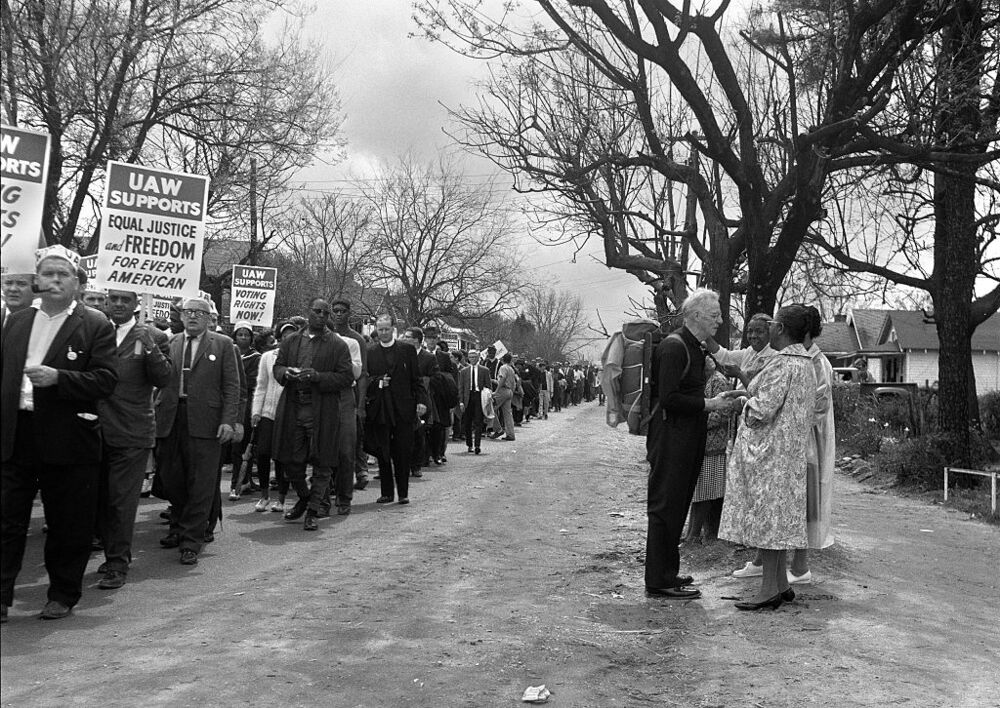 On the right side. Photographer: Stephen F. Somerstein/Archive Photos/Getty Images
Politically and economically, unions are sort of an odd duck. They aren’t part of the apparatus of the state, yet they depend crucially on state protections in order to wield their power. They’re stakeholders in corporations, but often have adversarial relationships with management. Historically, unions are a big reason that the working class won many of the protections and rights it now enjoys, but they often leave the working class fragmented and divided — between different companies, between union and non-union workers, and even between different ethnic groups.
Economists, too, have long puzzled about how to think about unions. They don’t fit easily into the standard paradigm of modern economic theory in which atomistic individuals and companies abide by rules overseen by an all-powerful government. Some economists see unions as a cartel, protecting insiders at the expense of outsiders. According to this theory, unions raise wages but also drive up unemployment. This is the interpretation of unions taught in many introductory courses and textbooks.
If this were really what unions did, it might be worth it to simply let them slip into oblivion, as private-sector unions have been doing in the U.S.:
But there are many reasons to think that this theory of unions isn’t right — or, at least, is woefully incomplete.
First, even back in the 1970’s, some economists realized that unions do a lot more than just push up wages. In a 1979 paper entitled “The Two Faces of Unionism,” economists Richard Freeman and James Medoff argued that “by providing workers with a voice both at the workplace and in the political arena, unions can and do affect positively the functioning of the economic and social systems.”
Freeman and Medoff cite data showing that unions reduced turnover, which lowers costs associated with constantly finding and training new workers. They also show that unions engaged in political activity that benefited the working class more broadly, rather than just union members. And they showed that contrary to popular belief, unions actually decreased racial wage disparities. Finally, Freeman and Medoff argue that by defining standard wage rates within industries, unions actually reduced wage inequality overall, despite the cartel-like effect emphasized in econ textbooks.
But the world didn’t listen to Freeman and Medoff, and private-sectors unions declined into near-insignificance. Now, four decades later, economists are again starting to suspect that unions were a better deal than the textbooks made them out to be. A recent paper by economists Henry Farber, Daniel Herbst, Ilyana Kuziemko and Suresh Naidu concludes that unions were an important force reducing inequality in the U.S.
QuicktakeIncomeInequality
Since past data tends to be patchy, Farber et al. combine a huge number of different data sources to get a detailed picture of unionization rates going all the way back to 1936, the year after Congress passed a law letting private-sector employees form unions. The authors find that as unionization rises, inequality tends to fall, and vice versa. Nor is this effect driven by greater skills and education on the part of union workers; during the era from 1940 through 1970, when unionization rose and inequality fell, union workers tended to be less educated than others. In other words, unions lifted the workers at the bottom of the distribution. Black workers, and other nonwhite workers, tended to benefit the most from the union boost.
Now, however, private-sector unions are mostly a faded memory and their power to raise wages has waned — Farber et al. find that although there’s still a union wage premium, it’s now much more due to the fact that higher-skilled workers tended to be the ones who stayed unionized. A 2004 paper by economists John DiNardo and David Lee found that by 1984-1999, unions had lost much of their ability to force wages higher.
Given the contrast between the golden age of 1940-1970 and the current age of spiraling inequality, wouldn’t it make sense to bring unions back? Perhaps. The key question is why private-sector unions mostly died out. Policy changes — right-to-work laws, and the appointment of anti-union regulators, probably played a key role in reducing unionization. But globalization may have also played a big part. Competition from companies in countries like Germany — where unions often bargain to hold down wages in order to increase their companies’ competitiveness — might have made the old American model of unionization unsustainable. Now, with even stiffer competition from China, the challenge of re-unionizing the U.S. might be an insurmountable one.
But it might be worth it to try. Other than massive government redistribution of income and wealth, there’s really no other obvious way to address the country’s rising inequality. Also, there’s the chance that unions might be an effective remedy for the problem of increasing corporate market power — evidence suggests that when unionization rates are high, industry concentration is less effective at suppressing wages. Repealing right-to-work laws and appointing more pro-union regulators could be just the medicine the economy needs.
So supporters of free markets should rethink their antipathy to unions. As socialism gains support among the young, both economists and free-market thinkers should consider the possibility that unions — that odd hybrid of free-market bargaining and government intervention — were the vaccine that allowed the U.S. and other rich nations to largely escape the disasters of communism in the 20th century.
It looks like it’s time for a booster shot.
This column does not necessarily reflect the opinion of the editorial board or Bloomberg LP and its owners.

June 6, 2019
Today, we remember D-Day.
75 years ago, the largest amphibious assault ever was launched, paving the way for Germany’s defeat in World War II. https://cnn.it/2Mwhtlg
Today is 75 years since D-Day. Today we remember.
Today, we remember D-Day. 75 years ago, the largest amphibious assault ever was launched, paving the way for Germany's defeat in World War II. https://cnn.it/2Mwhtlg
Posted by CNN on Thursday, June 6, 2019
May 15, 2019
This desert farm is harvesting food using nothing but sunlight and seawater.
Harvesting food using sunlight and seawater
This desert farm is harvesting food using nothing but sunlight and seawater.
Posted by Mashable on Sunday, April 28, 2019
No harm in having a picnic, but keep in mind the day’s purpose. “It’s not a happy day,” vet says.
By Neil Steinberg May 26, 2019
:format(webp)/cdn.vox-cdn.com/uploads/chorus_image/image/63900481/Image__153___1_.0.jpg)
The Jerry Corp Memorial Highway is not long. A section of U.S. Highway 160, it runs two and a half miles through Ozark County, Missouri, 250 miles southwest of St. Louis.
A green highway sign flashes by, the name registers and some drivers may feel a passing curiosity: does anybody remember Jerry Corp?
Tom Dier remembers him.
“We weren’t really close or anything like that,” said Dier, 70. “He wasn’t in my platoon.”
A mortar platoon in Company C, First Battalion, 52nd Infantry. Corp was a radioman attached to the command post in Quang Ngai province Vietnam.
“We got to know each other that way,” said Dier, who grew up in Northbrook and has returned home to speak at the northwest suburb’s Memorial Day commemoration after the parade Monday. “You didn’t really get close to people too much.”
In fact, Dier has exactly one memory of Corp, but it’s a good one.
“Someone on the perimeter called in for a routine fire mission, asking for illumination,” Dier plans to say in his speech. “I dropped a round down the 81-millimeter mortar tube. The shot went out, and we waited for the familiar pop and the subsequent intense light that the round would provide as it drifted slowly back to the ground for several hundred feet in the air.
“The descending illumination revealed a nearby hillside covered in jungle. Jerry and I laughed as the flare drifted toward the hillside, watching a multitude of chirping birds who mistook the flare for a sunrise. The noise from the birds stopped suddenly—as if a switch had been flipped—when the flare burned out.”
That’s it. And if you’re wondering how Dier would remember such a small moment with a stranger in a long-ago war in a far-off country, it’s because Corp was killed the next day—his platoon was trying to flush out a sniper, and in the confusion Corp stepped on a Vietcong boobytrap attached to a grenade. It was April 21, 1970, one week after his 20th birthday.
“Beyond that night, it’s hard to remember too much about Jerry.”
Dier was drafted at Christmas, 1968. He spent 10 months and 29 days in Vietnam and won the Silver Star for gallantry. He moved to Tennessee in 1972, worked as a house painter and raised three boys.
“All very responsible citizens,” he said. “One thing I taught them is how to work.”
Like many Vietnam veterans, he at first tried not to think about the war, but eventually circled back, writing a book about his experiences, “Miss Li Thi Van & Other Stories of Vietnam.”
How, I wondered, did the memory of those who died affect his post-war life?
“I wasn’t a great fan of the war,” Dier replied, “but I have never felt that the country owed me anything because there were a lot of guys who didn’t come home. There was one guy, he lost both arms and both legs; I feel guys like that really pay the bigger price. I never was wounded. I did what I was supposed to do, but I never felt I was owed anything, because other guys paid a much steeper price. I feel very blessed I made it.”
And how should the American public mark Memorial Day?
“There’s no harm in having a picnic,” Dier said. “But I don’t like when people say ‘Happy Memorial Day.’ It’s not a happy day, it’s a very solemn day for me. The guys who sacrificed, they paid the ultimate price.”
Dier mentioned a scene in “Saving Private Ryan,” where a surviving vet is asked if he lived the type of life that justified his surviving.
“His friends who didn’t survive, did his life honor them?” Dier said. “I’ve often thought of that. When I first came home, I wasn’t living the right way. Eventually I had a different way of looking at things, I really appreciated I survived. I didn’t have self-pity. I was blessed. I thought, ‘There has got to be a reason I made it, today.’ I realized I had a purpose.”
One of the things Dier felt he had to do was visit Jerry Corp’s mother, Irene, in Ozark County.
:format(webp):no_upscale()/cdn.vox-cdn.com/uploads/chorus_asset/file/16300891/Jerry_Corp_03_copy.jpg)
“We never got used to Jerry not coming home,” she told him. But Jerry’s mother, now 92, also said something else.
“Irene has mentioned that she lost her son but, at the same time, she gained many sons”—Corp’s former comrades who call, write, visit, keep tabs.
“There are things we can do or say that make a difference,” Dier said.
Wild Rice is Feeding Indigenous Communities in Detroit and Beyond
Dedicated tribes are working to protect and revive Manoomin, weaving it back into Native diets and the fabric of the community in the Upper Midwest.
By Jo Erickson, Health, Indigenous Foodways May 27, 2019

Civil Eats is a sponsor of the Feet in 2 Worlds journalism workshop, Telling Immigrant Food Stories, taking place in San Francisco May 31-June 2. This article originally appeared in the Feet in 2 Worlds Magazine, and is reprinted with permission.
When Renee Dillard tastes freshly cooked wild rice harvested by her hands, she feels a spiritual connection to the “sacred food” of her people. That spell is broken when she tastes the wild rice that most of us buy and eat.
Native wild rice, often referred to as Manoomin, which means “the good berry” in Ojibwe, isn’t the perfectly uniform dark brown long grains you find in supermarkets. Although it has the same name, much of that rice is commercially grown and has been genetically engineered. Just because the label says it’s wild, that’s not always true. Native wild rice, with flecks of brown and yellow, has a grass-like quality and a subtle flavor.
“As soon as I put that mass-cultivated rice on my tongue I can taste the emptiness,” Dillard says. “This food is soulless. It doesn’t fill me with life or joy, but reminds me of caged chickens who never see the light of day, nor touch the ground . They don’t know who they are. This rice is empty.”

Renee Dillard parching wild rice. Photo by Jo Erickson.
Dillard is a traditional ricer and basket weaver from the Little Traverse Bay Bands of Odawa Indians, based in the northern part of the state. Through spoken word she has learnt about the ancestry of wild rice from elders in her community.
Dillard is a survivor of the U.S. government boarding school experiment to “Americanize” her and her community. “I’ve been kidnapped, abused and robbed of language, culture and everything that makes me who I am,” she says.
Now in her 50’s, she teaches the next generation the traditions of weaving with wild rice stalks and stewardship of the land and lakes. During last winter’s Arctic freeze that covered most of the Midwest, Dillard was out in the woods with her long grey hair fighting the wind, her traditional moccasin shoes knee-deep in the snow, observing the changes of the seasons. With the arrival of spring, the 57-year-old waits for the first shoots of wild rice.
Dillard remembers when she was very young she’d walk to the edge of reservation and there would be wild rice growing. But with urban development, pollution, and the threat of GMO seed contamination, native wild rice is struggling to survive. Dillard is part of a movement to restore wild rice in Michigan.
For the past 10 years several tribes, including the Little Traverse Bay Bands of Odawa Indians, and the Lac Vieux Desert Band of Lake Superior Chippewa Indians have come together to form Michigan’s wild rice restoration project where they can track and restore native wild rice in the state’s rivers and lakes.
Shiloh Maples, 33, lives and works in the heart of downtown Detroit. She brings her passion for Native foods to city streets, food banks, and community gardens. Working for American Indian Health Family Services she helps provide food relief to Native Americans and other struggling communities living below the poverty line. As the program manager for food sovereignty and wellness, her mission is to develop the concept of food sovereignty.
Marginalized communities are empowered to have a stake in the food system, to control what they eat, and how they eat it. About seven years ago Shiloh noticed that a lot of families relied on local corner stores for their food or food stamps. With limited finances and no transportation, struggling families had to make do with whatever food they had access to. Often it was canned foods and junk food.
Under the program Shiloh manages they have a choice. Native Americans can get traditional, culturally appropriate foods including wild rice soups, berries, fish and turkey.
Shiloh’s work on food sovereignty within the indigenous community has led her to develop community gardens in Romanowski Park that grow traditional foods, and cooking classes to rediscover traditional Native American meals. “As the community garden grew, the community realized that they cared about how their food was grown,” she said. “Was it done in an ethical way? Did it respect mother earth? They wanted to make sure that culture and tradition were part of how their food is produced. So that means incorporating song and ceremony and prayers to the planting and harvesting.”
With the help of Shiloh’s project poverty-stricken families feel they can make life-changes. “It’s exciting to watch. They’re making connections of where their food comes from and their relationship to that food. That changes people, ” she said.
Food offers an emotional connection to urban tribes-people in cities including Detroit, Seattle and Chicago who are looking to strengthen bonds to family and cultural roots.
Shelley Means, 55, is one of the many city dwelling tribes people who see traditional meals and sharing stories over food as keys to unlock history and family traditions. Shelley’s mother is from the White Earth Nation and her father was Lakota. She grew up in the city knowing very little of her family history.
As a young girl she recalls that her grandfather would send packets of wild rice and occasionally they would visit him for gatherings in Bemidji, Minnesota. She realized that some of her most powerful childhood memories are gatherings where hundreds of tribe members gathered for meals with bowls of wild rice. “I can’t remember much about the reason for the gathering, but I do remember the smell and taste of wild rice,” she recalls.

A boat-sized haul of wild rice. Photo by Jo Erickson.
These memories drove Shelley to seek out family members who could tell her more about her family and traditions. One of her aunts told her what she knew so that Shelly could in turn pass on family history to her son.
Whenever she thinks about wild rice, she thinks about her family. She smiles as she recalls how her uncle would grind the grain to make bread and her mother prepared wild rice, “She’d heat it up in the microwave, then put a bit of milk and black pepper, that’s her favorite thing.”
According to Barb Barton, Aquatic Resource Specialist at the Michigan Department of Transportation, restoring native wild rice across the state will take several years to accomplish.
One of the biggest challenges is the decimation of wild rice found in the north of the state. “There were 212 historical wild rice sites scattered across the state dating back to the 1800’s, but only 14 are known to still exist,” says Barton, author of “Manoomin: The Story of Wild Rice in Michigan.”
Zizania palustris, a native wild rice plant found in northern Michigan, is on the threatened species list. In the last two years Michigan’s Department of Natural Resources has worked with tribes to restore some of the old rice sites.
In Michigan wild rice harvesting is unregulated. That’s in contrast to Minnesota and Wisconsin, where state laws give tribes sovereignty over wild rice. Tribal members carry permits to harvest rice and non-tribal ricers buy licenses. Despite these challenges, Michigan’s wild rice restoration project has replanted and manages 136 native wild rice beds. At the same time more and more urban tribes people are rediscovering the value of returning to a traditional diet of wild rice.
There is still a long way to go before northern wild rice is taken off the threatened species list. If Michigan were to lose its native wild rice, “it would be devastating,” says Shelly Means. “The stories will still be here, but the rice will not.”