Rachel Maddow Show Fans
December 17, 2019

Lonnie Cunningham
Read About The Tarbaby Story under the Category: About the Tarbaby Blog

December 15, 2019

At the Zenger Group printing plant in Buffalo, New York, Christmas came early … really early. It was August when holiday cards were rolling off the presses –a summer-time snowdrift of paper, each card as individual as a snowflake.
You might think in these digital days of ours that sending greeting cards like these is a bit old-fashioned. But for the very special artists who paint them, it’s anything but just a quaint tradition.
“I would love just for people to just enjoy the piece for what it is, and not necessarily be taken back by the way that I’m doing it,” said artist Alana Tillman.
She was born with a condition that left her arms locked in place, but she’s been drawing with her mouth since he was a kid.
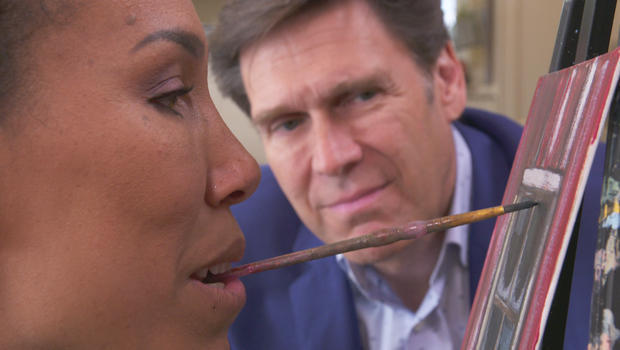
“No one taught you how to do it? You just figured it out?” asked correspondent Lee Cowan.
“No, I just kind of figured it out,” Tillman said. “I’ve always had to prove myself to people that I am capable. Doubters in my life just made me want to achieve even more.”
Then there’s artist Brom Wikstrom: “When I got out of the hospital it was just something to maintain my sanity, you know, to give me something to do,” he said.
“More therapy than anything?” asked Cowan.
“Yeah, to help me feel better about myself.”
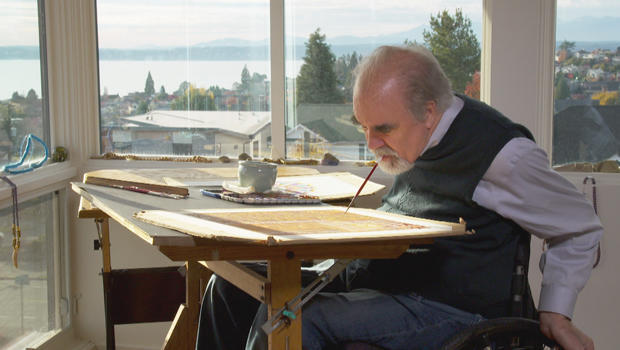
Wikstrom was paralyzed at age 21, when he dove head-first into the Mississippi River in 1975. He’s been painting with his mouth almost every day since. “I would just paint from morning until night,” he said.
“So, it sounds like it’s almost a need for you to paint,” Cowan said.
“At this point, I can’t imagine what else I’d be doing.”
It’s remarkable to watch either of them paint – the detail, the finesse, the control.

And no, they don’t just paint holiday cards; they each have huge portfolios. But it’s the Christmas cards that have helped pave the way for their careers, and which have helped make possible an association called the Mouth and Foot Painting Artists. Its name takes a bit of getting used to, but not its goal: the money from its Christmas cards goes to financing disabled artists. It’s not about charity; it’s about empowerment.
It is, said Jim March, the director of North American Operations, “very much not a non-profit. They’re very proud of not being a non-profit situation. It’s a business to make money to give them a living.”
The MFPA, as it’s called, was started in 1957 by Arnulf Erich Stegmann, a German painter who had lost the use of his hands due to polio. Despite his challenges, he became an accomplished artist and publisher, who sought out other painters like him to help further their skills and build their careers.

Today, there are about 800 artists who are members of the association, and every one of them gets a monthly stipend based on their skill level. They enter as student members, like Alana Tillman, who lives on her own in Santa Rosa, California. She gets enough to pay for art courses as well as supplies, and it certainly helps pay the rent.
“Before they came along, I was just living off of my Social Security. I didn’t really feel like I was a contributing member to society,” she said.
“So, has it given you a sense of independence?” asked Cowan.
“Way more independence.”
She’s adapted to just about everything, including driving to work. She now owns her own business, called ArtXcursion, where she offers painting lessons (people don’t have to paint with their feet or mouth), with a side of wine and appetizers.
“Talking about my adversities, I think is what kind of helps them realize that they can actually do it, too,” Tillman said.
Brom Wikstrom has been with the MFPA so long, he gets a full salary, the equivalent of what any other commercial artist near his home in Seattle might be paid. “I thought that I was going to be on public assistance, or you know, how was I going to make it?” he said.
Now he’s on the payroll forever, regardless of whether he stops painting or not. “It is a lifetime position now, so if physically I was incapable of working, they would be there for me,” he said.
That’s a relief not only for him, but for his wife of 30 years, Anne. The association, she said, has not only provided Brom with a living wage, but something much harder to quantify: Confidence.
Wikstrom works part-time at the Burke Museum at the University of Washington, and he volunteers at schools, showing children that, yes, anything really is possible.
As successful as both Wikstrom and Tillman have become, their daily struggles remain. But what they hope can be changed is perception.
They want to be seen simply as artists, not “disabled artists,” who at this time of year are truly making our season bright.
“I think people do us kind of a double kindness because they’re buying our cards, but they also get to send those cards out to their loved ones,” Wikstrom said. “And it seems like such a small thing but it means a lot.”
For more info:
December 14, 2019

The social media wins again!

Emily and Kullen Langston were enrolling in classes for the winter semester at Brigham Young University-Idaho when they hit an unexpected roadblock.
The school, like many others, requires all students to have health coverage. But this month, the university made an unusual announcement: It would no longer accept Medicaid.
Emily Langston, 20, enrolled in the free government insurance program last year after becoming pregnant with the couple’s daughter, who is now 4 months old. Kullen Langston, 22, was planning to sign up for Medicaid in January, when it is set to expand in the state.
To remain in school, they would have to buy private coverage. The cheapest option available is the university’s student health plan, which does not comply with the Affordable Care Act’s consumer protections and would require the Langstons to pay a $3,125 annual premium.
Emily Langston said her family, which relies on the income her husband earns as a call-center operator, cannot afford that. She had hoped to become a teacher, but now intends to drop out of school, and her husband is unsure whether he will attend.
“I’m disappointed that they’re showing prejudice against those of us who are poor right now,” Emily Langston said. “I’m disappointed that I’m not going to be able to finish school.”
The decision on the eastern Idaho campus has confused and angered students. The change is set to go into effect on Jan. 1, the same day Idaho will expand Medicaid coverage to about 70,000 low-income residents, including college students.
In an email last week to its 19,000 students in Idaho, the university appeared to tie its decision to the Medicaid expansion. It’s not clear how many students currently have Medicaid coverage, but the state projects that about 2,400 more people in Madison County, where the school is, would enroll with the expansion. The university warned that having too many students sign up for the public program “would be impractical for the local medical community,” an assertion a local hospital official rejects.
The policy change is likely to push more students into a health plan administered by Deseret Mutual Benefits Administration, which, like the university, is owned by the Church of Jesus Christ of Latter-day Saints.
That plan limits annual benefits and doesn’t cover birth control — provisions that would violate the Affordable Care Act, but for a little-noticed Obama-era exemption for universities that fund their own health plans.
“It seems like a loophole, and is pretty misleading to students,” said Erin Hemlin, who oversees health policy at Young Invincibles, a nonprofit that focuses on issues affecting college students and young adults. “It’s called a student health plan, so you would think it’s going to be comprehensive coverage, and it isn’t.”
The church has been vocal on aspects of the Affordable Care Act, including religious freedom and the health law’s birth control mandate, but it has remained quiet on Medicaid expansion. It has never taken a public position on the issue, a church spokesman confirmed. The university’s Idaho campus and the church both declined to comment on the policy change.
Before the Affordable Care Act, student health plans across the country varied significantly from one campus to another. Some offered robust health benefits, while others had maximum annual benefits as low as $5,000.
The Obama administration required that most university plans comply with the new law by covering a wide array of essential health benefits, including maternity care and prescription drugs, and eliminating annual benefit caps.
The rules, issued in 2013, included a carve-out for a small number of universities that “self-funded” their health plans, meaning they used student premiums to cover costs — and accepted responsibility for any large bills that might cost even more. At the time, about 30 universities had such plans.
Most were big institutions with large endowments, such as the University of California, Johns Hopkins and Princeton. Those three, and some others, chose nevertheless to make their self-funded student plans comply with the Affordable Care Act.
But Brigham Young University campuses in Utah, Idaho and Hawaii did not. The university publicly opposed the law’s requirement to cover contraceptives. And its plans limited the maximum annual benefit. At the time, a university spokesman told the campus newspaper in Utah, “There are numerous government-imposed requirements that we don’t believe are necessary to provide good health care to our students.”
The Idaho campus’ plan has a $4,750 deductible that must be met before it will cover maternity care for the spouse of a student. It does not cover certain major medical services, such as residential mental health care and care related to an organ transplant.
These restrictions, along with the premium costs, are central reasons Idaho students with Medicaid coverage object to buying the university’s student plan. “It feels like they’re forcing us into a noncompliant health plan when the one we have is already compliant with Obamacare,” said Amanda Emerson, a 26-year-old student. “They’re making it really difficult to do anything otherwise.”
Deseret Mutual Benefit, the plan administrator, says that limiting benefits helps keep premiums down. “The purpose is to try to provide a plan as inexpensively as possible to the students,” said Andy Almeida, the company’s chief operating officer.
The Idaho campus is the only Brigham Young site that will no longer accept Medicaid as a substitute for the student health plan, a decision that university officials would not explain. The school’s Utah and Hawaii campuses allow students with Medicaid to waive private coverage.
Utah voters agreed to a Medicaid expansion last year, and a partial version of the program took effect in February. The state does not provide data on how many of the 33,000 students at the Provo campus are enrolled in Medicaid. The Hawaii campus has just 2,500 students; the number on Medicaid is not disclosed.
Idaho had long resisted participating in the Affordable Care Act’s expansion of Medicaid, which provides coverage to Americans who earn less than 133% of the federal poverty level ($16,612 for an individual, and $34,248 for a family of four).
The state Legislature twice voted down bills that would have added Idaho to the program, which currently covers 36 states and the District of Columbia. In 2018, local activists secured a ballot initiative on the issue. The proposal passed with a double-digit margin and after a state Supreme Court challenge, the program will start in January.
In announcing its new stance on Medicaid, Brigham Young University-Idaho cited a worry about overwhelming local health care providers. The local hospital, however, said it had no such concerns and had not raised the issue with the university.
“We have some great providers here, and we feel like we’re able to handle any growth that the university and the community would need,” said Doug McBride, executive director of business development at Madison Memorial Hospital, a county-owned facility.
Since the school announced the new policy this month, students have organized Facebook groups and circulated petitions opposing the change.
Emerson, one of the students with Medicaid, is planning to enroll in a private plan in addition to her public coverage. Her husband, also a student at the Idaho campus, plans to do the same. They said they had discussed their options with a local insurance broker and found that the student plan would be the cheapest, but hadn’t yet made a decision.
“We only have a few weeks until we have to be registered for new classes, so this kind of dropped a bomb on us,” Emerson said. “We only have one semester to go, so we’re willing to dip into our savings.”
This article originally appeared in The New York Times.

November 20, 2019
This sharpie isn’t very sharp; he didn’t make it past the 4th grade. John Hanno
Imagine being so stupid that you have to write these notes to stay on message:
I WANT NOTHING
I WANT NOTHING
I WANT NO QUID PRO QUO


Donald Trump said more than a few ridiculous things in his remarks today to the Economic Club of New York, but the president’s claim about one of his adult children was especially jarring.
President Trump claimed Tuesday that his daughter Ivanka Trump – who is also a White House senior adviser – has created 14 million jobs, according to Mediaite. “My daughter Ivanka, that’s all she wants to talk about… she wants to make these people have great lives. And when she started this, two and half years ago, her goal was 500,000 jobs,” the president said at the Economic Club of New York while discussing the administration’s “Pledge to America’s Workers.”
“She has now created 14 million jobs and they are being trained by these great companies, the greatest companies in the world, because the government cannot train them. It’s a great thing.”
If you watch the video clip, note that the president repeated the line more than once – and then promoted it on Twitter.
If true, this would be quite an accomplishment for the president’s adult daughter, wouldn’t it? Donald Trump has already tasked Ivanka Trump for playing key roles in international diplomacy, and he’s considered her for powerful positions, including posts at the World Bank and the United Nations.
What we didn’t know is that, in addition to these other areas of her portfolio, the young White House official also managed “create 14 million jobs,” apparently very quickly.
If true, that would be quite an accomplishment. In reality, however, the claim is not to be taken seriously.
According to the latest data from the Bureau of Labor Statistics, Donald Trump has been in office for 33 full months, during which time the economy has created 6.25 million jobs. That’s pretty good, though it’s a significant decline as compared to the final 33 months of Barack Obama’s presidency.
But to hear the Republican tell it, while he wants credit for creating 6.25 million jobs, he wants his daughter to receive credit for creating 14 million jobs – more than double that of his entire presidency.
If this sounds at all familiar, it’s because the president made a similar boast in February, telling the nation’s governors, “My daughter has created millions of jobs. I don’t know if anyone knows that, but she’s created millions of jobs.”
Now, he’s even more specific: “millions of jobs” has become “14 million jobs.” I shudder to think where the made-up number will be next year.
What Ivanka Trump actually did was help launch a “Pledge to America’s Workers” initiative in which many companies pledged to help train workers over the course of several years. That’s a worthwhile thing to do, but evidence of actual training is, at least at this point, rather thin, and none of this has anything to do with millions of jobs having been created by the effort.
What the president doesn’t seem to understand is that implausible lies with no grounding in reality in are literally unbelievable.