How many US mass shootings have there been in 2023?
May 9, 2023
Data shows gun ownership in the US has grown over the last several years
Gun violence is a fixture in American life – but the issue is a highly political one, pitting gun control advocates against people who are fiercely protective of their right to bear arms.
We’ve looked into some of the numbers behind firearms in the US.
Mass shootings on the rise
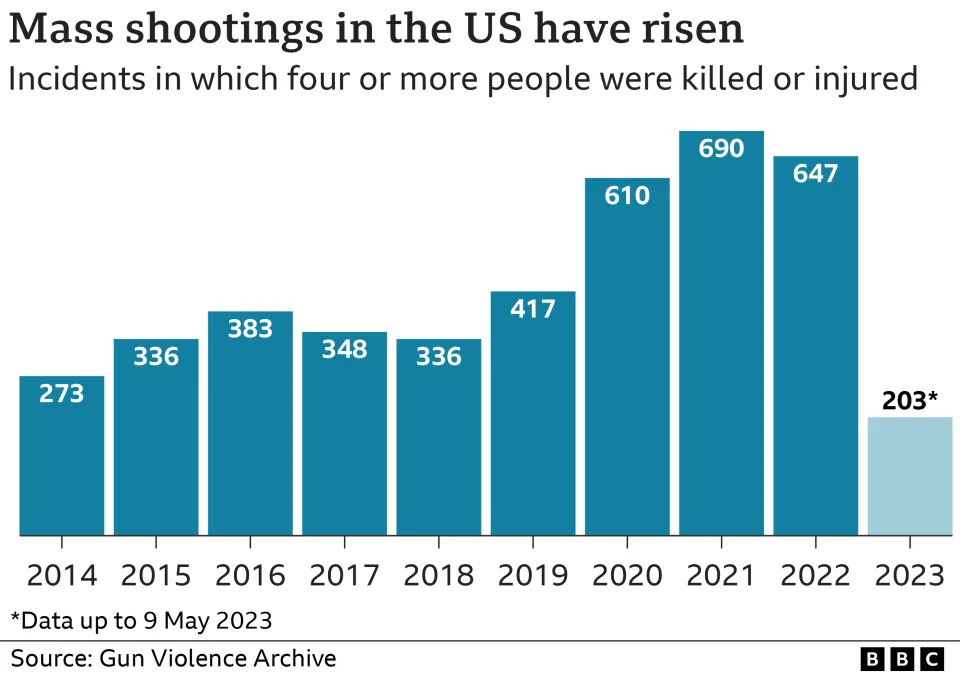
There have been more than 200 mass shootings across the US so far this year, according to the Gun Violence Archive, which defines a mass shooting as an incident in which four or more people are injured or killed. Their figures include shootings that happen in homes and in public places.
There have been two in Texas in the last week – five killed at a home in Cleveland, north of Houston, and eight dead at a shopping mall in Allen, near Dallas.
In each of the last three years, there have been more than 600 mass shootings, almost two a day on average.
The deadliest such attack, in Las Vegas in 2017, killed more than 50 people and left 500 wounded. The vast majority of mass shootings, however, leave fewer than 10 people dead.
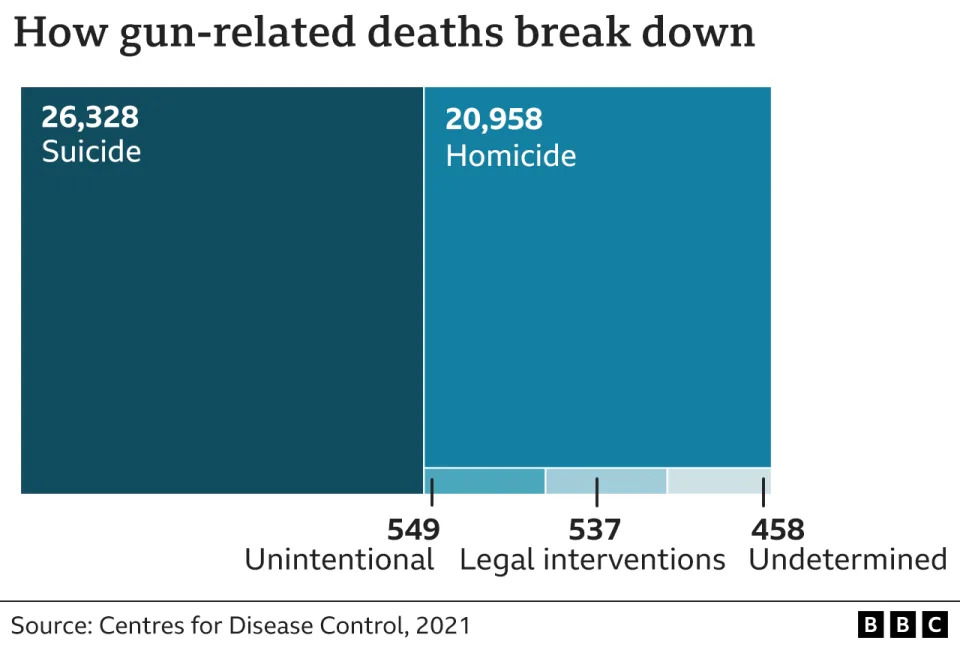
Data shows more than 50 people are killed each day by a firearm in the US.
That’s a significantly larger proportion of homicides than is the case in Canada, Australia, England and Wales, and many other countries.
Graphic showing an international comparison of gun-related killings as a percentage of all homicides in each country. The US leads with nearly 79% of all homicides occurring with guns.
How many guns are there in the US?
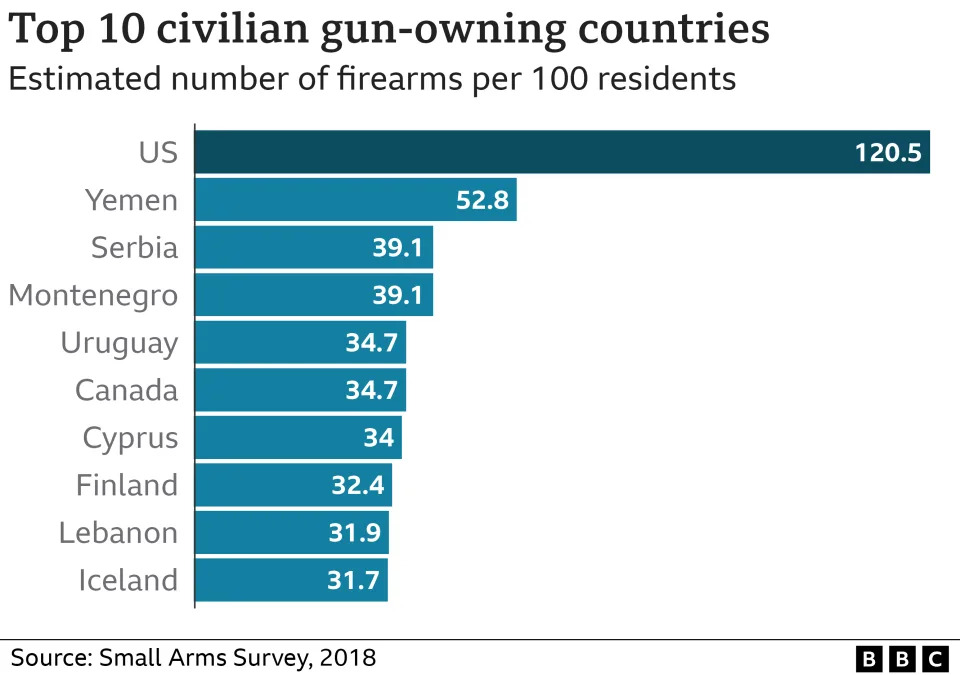
While calculating the number of guns in private hands around the world is difficult, the latest figures from the Small Arms Survey – a Swiss-based research project – estimated that there were 390 million guns in circulation in the US in 2018.
The US ratio of 120.5 firearms per 100 residents, up from 88 per 100 in 2011, far surpasses that of other countries around the world.
Chart showing civilian gun ownership around the world
More recent data out of the US suggests that gun ownership grew significantly over the last few years. A study, published by the Annals of Internal Medicine in February, found that 7.5 million US adults became new gun owners between January 2019 and April 2021.
This, in turn, exposed 11 million people to firearms in their homes, including 5 million children. About half of new gun owners in that time period were women, while 40% were either black or Hispanic.
Who supports gun control?
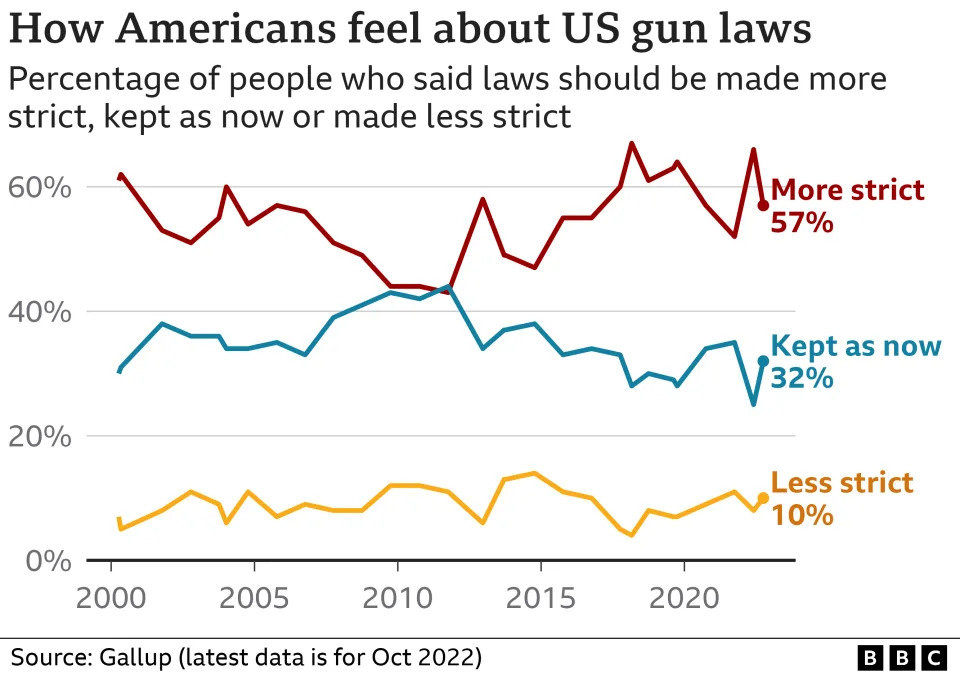
A majority of Americans are in favour of gun control.
57% of Americans surveyed said they wanted stricter gun laws – although this fell last year – according to polling by Gallup.
32% said the laws should remain the same, while 10% of people surveyed said they should be “made less strict”.
Gun control opinion
The issue is extremely divisive, falling largely along party lines.
“Democrats are nearly unanimous in their support for stricter gun laws,” another Gallup study noted, with nearly 91% in favour of stricter gun laws.
Only 24% Republicans, on the other hand, agreed with the same statement, along with 45% of Independent voters.
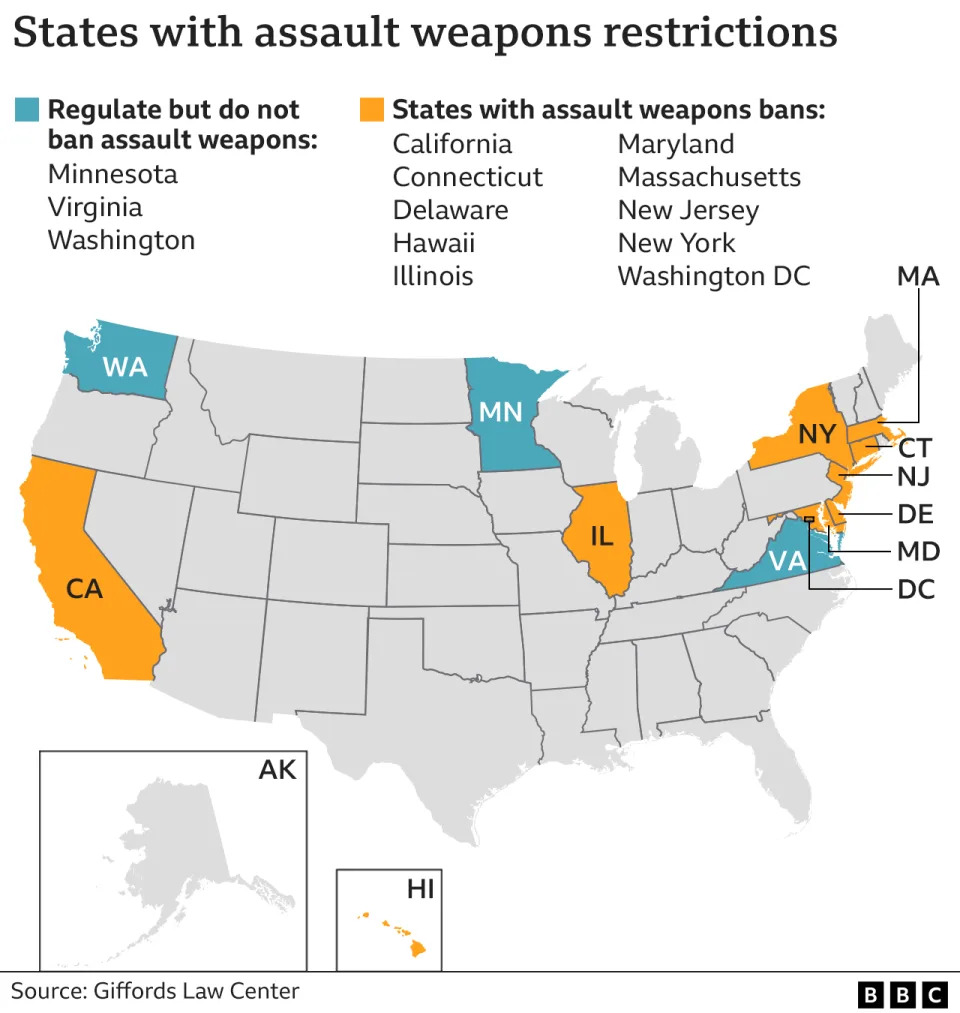
Some states have taken steps to ban or strictly regulate ownership of assault weapons. Laws vary by state but California, for example, has banned ownership of assault weapons with limited exceptions.
Map showing states with assault weapon bans – California, Connecticut, Delaware, Hawaii, Illinois, Maryland, Massachusetts, New Jersey, New York & Washington DC, and those with restrictions Minnesota, Virginia and Washington, March 2023
Some controls are widely supported by people across the political divide – such as restrictions governing the sale of guns to people who are mentally ill or on “watch” lists.
Who opposes gun control?
Despite years of financial woes and internal strife, the National Rifle Association (NRA) remains the most powerful gun lobby in the United States, with a substantial budget to influence members of Congress on gun policy.
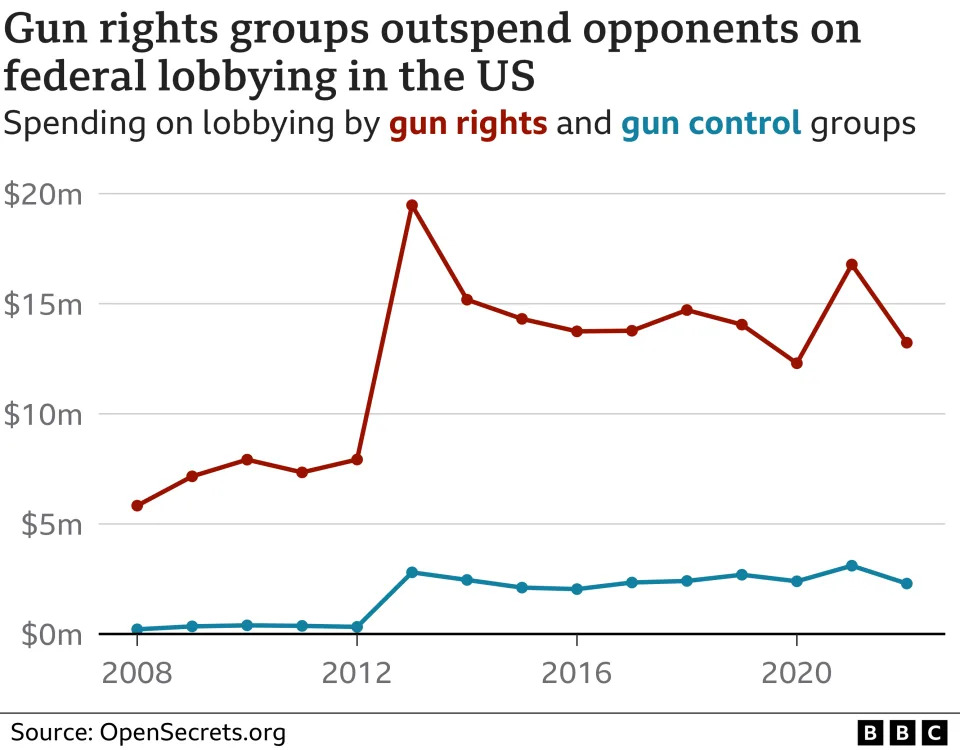
Over the last several election cycles, it, and other organisations, have consistently spent more on pro-gun rights messaging than their rivals in the gun control lobby.
A line chart showing the amount spent per year by gun rights groups and gun control groups on federal lobbying in the US from 2008 to 2022. Gun rights groups have consistently spent more than double what gun control groups have. Gun rights spending peaked in 2013 at just under $20m – gun control groups spent just under $3m in the same year. In 2022, gun rights groups spent $13m, while their opponents spent $2.3m.
A number of states have also gone as far as to largely eliminate restrictions on who can carry a gun. In June 2021, for example, Texas Governor Greg Abbott signed into law a “permitless carry bill” that allows the state’s residents to carry handguns without a licence or training.
Similarly, in April last year Georgia became the 25th in the nation to eliminate the need for a permit to conceal or openly carry a firearm. The law means any citizen of that state has the right to carry a firearm without a licence or a permit.
The law was backed by the NRA, and leaders within the organization called the move “a monumental moment for the Second Amendment”.
Why are mass shootings rare in other countries despite high levels of gun ownership?
Justin Klawans, Staff writer – May 9, 2023
Guns. Illustrated | Gettyimages
There is no question the United States has a ton of guns — more than anywhere else in the world by far. There are an estimated 352 million guns in private circulation in the U.S., according to data collected by The Trace, and some other studies cited by the outlet suggest the number is even higher.
It comes as no surprise, then, that the U.S. leads the world in mass shootings. There have already been over 180 of these incidents in 2023 alone, The New York Timesreports. Many mass shootings occur in schools; since the Columbine High School shooting in 1999, more than 352,000 students have experienced gun violence in the classroom, according to The Washington Post.
While the United States leads the world in number of firearms, it’s hardly the only country where gun ownership is high. Yet in most other countries, mass shootings are rare, if not unheard of, mainly due to gun laws being significantly stricter than they are in the U.S. Between 2009 and 2015, there were just 19 mass shootings in all of Europe, research shows. School shootings are even rarer, and World Population Review reports that every country besides the U.S. has had less than 10 of them in 2023. These are five nations that have high numbers of firearms but little trouble with shootings.
Finland
There are an estimated 1.5 million licensed firearms in Finland, the country’s interior ministry reports, in a nation of just 5.6 million. This high rate of gun ownership is due to an activity widely seen in Finland (and many other nations): hunting. Finns “have hunted and fished for food for thousands of years,” Slatereports, and “hunting remains a popular weekend, or even after-work, activity.” Finland’s large area provides ample space for the hunting industry to flourish.
Despite this, Finland has had less than five documented cases of mass shootings. This is because, like most of the Nordic countries, Finland has highly regulated gun control laws. Following a school shooting in 2007, Finnish Parliament raised the minimum age to purchase a gun from 15 to 18, and the prospective buyer must fill out a detailed application to receive a handling license. The interior ministry has also implemented “changes to the provisions on the storage of firearms, component parts of firearms, and cartridges,” as well as additional legislation to ensure guns remain safely locked away when not in use.
Switzerland
Like Finland, hunting is a part of life in Switzerland, which may be why the Alpine country has approximately 2 million privately owned guns, Insiderreports, in a country of just 8.7 million people. Despite this staggeringly high rate of gun ownership, though, there has not been a mass shooting in Switzerland in more than 20 years.
Insider notes that the U.S.’ National Rifle Association often points to Switzerland as an example of gun laws not being necessary, because they claim the Swiss have limited legislation on firearms. But this is simply not true. Firearms in Switzerland are highly controlled and regulated, according to the official Swiss Confederacy portal. Semi-automatic rifles with large magazines are banned, and people who want to purchase handguns or smaller magazine semi-automatic rifles must undergo a permitting process and send their weapon’s information to the government.
Canada
Canada’s vast northern lands make it another ample country for hunting, which contributes to the 7.1 million firearms in private hands, according to the Canadian government, in a nation of 39 million people. This statistic lies in a similar range with comparable Western nations, the government notes, except the United States.
The country has had a few recent mass shootings, including one in 2020. Despite this, instances of mass violence remain very rare, Reutersreports. This is because Canada has some of the harshest regulations against assault rifles in the world, and the nation’s public safety arm notes Canada “has prohibited over 1,500 models of assault-style firearms and certain components of some newly prohibited firearms.” Many of these weapons became newly prohibited following the 2020 mass shooting, and there are also limits in the Canadian criminal code placing restrictions on the number of rounds in rifles, handguns and shotguns.
New Zealand
New Zealand also has a lot of guns — 1.5 million in a country of just 5.1 million people — but unlike the United States, New Zealand took legislative action after a tragedy.
Following a 2019 mass shooting in Christchurch that killed 51 people, then-Prime Minister Jacinda Ardern implemented a series of sweeping reforms to the country’s already strict gun laws. Ardern announced these reforms just one week after the shooting, Timereports, and the new laws were pushed through parliament almost immediately. The laws included creating a firearms registry and placing a complete ban on AR-15s and other assault rifles. New Zealand also created a gun buyback program to try and get weapons off the streets. By the end of the program, Kiwis had turned in more than 50,000 guns, NPR reports, greatly slashing the number of firearms on the streets of New Zealand.
Australia
Like their neighbors to the southeast, Australia also has a high rate of gun ownership, and the University of Syndey notes there are about 3.5 million registered firearms in the nation of 26.4 million. However, the university also reports that the “proportion of Australian households with a firearm has fallen by 75% in recent decades.”
This drop was similarly spurned by just a single tragedy: the 1996 Port Arthur massacre in Tasmania. Thirty-five people died in the worst mass shooting in Australian history, and the country’s conservative government enacted similar new restrictions on guns. This includes a national gun registry, and Time notes that firearm license applications must prove the prospective owner has “a ‘genuine need’ to own weapons.” The Aussies also implemented a gun buyback program after Port Arthur, and Vox reports the country confiscated 650,000 weapons. There have been almost no mass shootings in Australia since then.
Putin tells WWII event West is waging a ‘real war’ on Russia
The Associated Press – May 9, 2023
Military vehicles move toward Red Square to attend a Victory Day military parade in Moscow, Russia, Tuesday, May 9, 2023, marking the 78th anniversary of the end of World War II. (AP Photo/Alexander Zemlianichenko)APTOPIX Russia Victory Day Parade Iskander, mobile short-range ballistic missile system launchers, drive past during the Victory Day military parade at Dvortsovaya (Palace) Square to celebrate 78 years after the victory in World War II in St. Petersburg, Russia, Tuesday, May 9, 2023. (AP Photo/Dmitri Lovetsky)
President Vladimir Putin declared Tuesday that the West has unleashed “a real war” against Russia, reprising a familiar refrain at scaled-down Victory Day celebrations that may reflect the toll the Ukraine conflict is taking on his forces.
Putin’s remarks came just hours after Moscow fired its latest barrage of cruise missiles at targets in Ukraine, which Russia invaded more than 14 months ago. Ukrainian authorities said air defenses destroyed 23 of 25 missiles launched.
The Russian leader has repeatedly sought to paint his invasion of Ukraine as necessary to defend against a Western threat. Kyiv and its Western allies say they pose no such threat and that Moscow’s war is meant to deter Western influence in a country that Russia considers part of its sphere of influence.
“Today civilization is once again at a decisive turning point,” Putin said at the annual commemorations celebrating the defeat of Nazi Germany in World War II. “A real war has been unleashed against our motherland.”
Putin has often used patriotic rhetoric that harkens back to the earlier war in an effort to rally his citizens and forces — and May 9 is one of the most important dates in the Russian political calendar. But this year’s celebrations were markedly smaller, at least partially because of security concerns after several drone attacks have been reported inside Russia.
Some 8,000 troops took part in the parade in Moscow’s Red Square on Tuesday — the lowest number since 2008. Even the procession in 2020, the year of the COVID-19 pandemic, featured some 13,000 soldiers, and last year, 11,000 troops took part. There was no fly-over of military jets, and the event lasted less than the usual hour.
“This is weak. There are no tanks,” said Yelena Orlova, watching the vehicles rumble down Moscow’s Novy Arbat avenue after leaving Red Square. “We’re upset, but that’s all right; it will be better in the future.”
The Kremlin’s forces deployed in Ukraine are defending a front line stretching more than 1,000 kilometers (600 miles), presumably thinning the ranks of troops available for such displays.
“This is supposed to be a showpiece for Russian military might. But so much of that military might has already been mauled in Ukraine that Russia has very little to show on its parade in Red Square,” said Keir Giles, a Russia expert at London’s Chatham House think tank.
Meanwhile, the traditional Immortal Regiment processions, in which crowds take to the streets holding portraits of relatives who died or served in World War II — a pillar of the holiday — were canceled in multiple cities.
“That seems to be for fear that those people who have lost their relatives in this current war on Ukraine might actually join the processions and show just the scale of the casualties that Russia has suffered in its current war,” Giles said.
Russian media counted 24 cities that also scrapped military parades — another staple of the celebrations — for the first time in years. Regional officials blamed unspecified “security concerns” or vaguely referred to “the current situation” for the restrictions and cancelations. It wasn’t clear whether their decisions were taken in coordination with the Kremlin.
Last week, Russia claimed it foiled an attack by Ukrainian drones on the Kremlin that it called an unsuccessful assassination attempt against Putin. Ukrainian President Volodymyr Zelenskyy denied involvement.
There was no independent verification of the purported attack, which Russia authorities said occurred overnight but presented no evidence to support it.
On a tribune in Red Square, Putin praised soldiers taking part in the war in Ukraine and urged Russians to stand together.
“Our heroic ancestors proved that there is nothing stronger, more powerful and more reliable than our unity. There is nothing in the world stronger than our love for the motherland,” Putin said.
The guest list was also light amid Putin’s broad diplomatic isolation over the war. Initially, only one foreign leader was expected to attend this year’s parade — Kyrgyz President Sadyr Zhaparov. That was one more foreign guest than last year, when no leaders went.
At the last minute on Monday, officials announced that the leaders of Armenia, Belarus, Kazakhstan, Tajikistan, Turkmenistan and Uzbekistan would head to Moscow as well.
Meanwhile, the Ukrainian air force said in a Telegram post that eight Kalibr cruise missiles were fired from carriers in the Black Sea toward the east and 17 from strategic aircraft.
The missiles came hours before European Commission President Ursula von der Leyen, the head of the European Union’s executive branch, arrived in Kyiv.
Von der Leyen urged EU member nations to take measures to prevent countries from helping Russia to circumvent the bloc’s sanctions. The EU has noticed that certain products that have been banned to undermine Russia’s war effort are still getting through, she said.
Von der Leyen did not name the countries, but unusual trade flows through China and Turkey have been on the EU’s radar for some time.
Ukraine is keen to join the EU, but membership has many requirements and is still a long way off. Ukraine is also hoping to join NATO, after moving close to the Western military alliance during the war.
In the latest help from a NATO member, the U.S. was expected to announce Tuesday that it will provide $1.2 billion more in long-term military aid to Ukraine to further bolster its air defenses.
A Colorado school board was taken over by Trump-loving conservatives. Now nearly half its high-school teachers are bailing.
Grace Eliza Goodwin – May 9, 2023
Desks and chairs arranged in classroom at high schoolMaskot / Getty Images
A newly elected conservative school board in Colorado is enraging many residents and teachers.
About 40% of the district’s high-school teachers have said they’re leaving next year, NBC News said.
The board has adopted a conservative teaching standard and argued against mental-health resources.
A Colorado school district’s board was taken over by conservatives aiming to emulate former President Donald Trump — and its new policies are set to drive off nearly half the district’s high-school teachers, NBC News reported.
At the end of 2021, a group of conservatives won control of the school district in Woodland Park, Colorado.
Since then, it has enacted a number of conservative policies that have infuriated many teachers, residents, and even staunch Republicans in the town of just 8,000 people, NBC News reported.
Nearly 40% of the district’s high-school teachers have decided to leave at the end of this school year, a district administrator told NBC News.
At least four higher-ups in the district have quit over the new board’s policies, according to interviews and emails viewed by NBC News.
“This is the flood the zone tactic, and the idea is if you advance on many fronts at the same time, then the enemy cannot fortify, defend, effectively counter-attack at any one front,” David Illingworth, a new member of the school board, wrote to another member shortly after being elected, NBC News reported.
“Divide, scatter, conquer,” he wrote. “Trump was great at this in his first 100 days.”
Among its most controversial new policies is the board’s decision to adopt the American Birthright social-studies standard. The curriculum standard, created by a conservative advocacy group, emphasizes patriotism, discourages civic engagement, and criticizes the federal government’s control of public schools, NBC News said.
The board also pushed against mental-health resources for students, with the superintendent musing how a school social worker didn’t help stop a student’s killing off campus, the NBC News report said.
A Refugee From Another Time Gets an Eviction Notice
Dan Barry – May 8, 2023
William Mackiw
NEW YORK — The travails of many can be lucrative for a few. Take the old Stewart Hotel in Manhattan, which is being used as temporary housing for some of the tens of thousands of migrants who have come north to New York in search of sanctuary.
The city is paying a $200 nightly rate for 611 rooms in the nearly century-old hotel. This comes to roughly $6,000 a month for each room, or about $3.66 million a month for the hotel’s owners.
While they collect favorable rates for their fully booked hotel, the owners are also suing to evict the wisp of a man paying $865 a month for Room 1810: William Mackiw, who has lived there for so long that no one knows when he first appeared. It has been decades.
At some point, he moved in with the rent-stabilized room’s tenant, his aunt Louise. At some point, she died. Again, it has been decades.
And he just kept paying the modest rent with what he earned as a waiter in restaurants of casual fare. Your Howard Johnson’s. Your Beefsteak Charlie’s. Month after month, year after year.
Mackiw, 82 and retired, lives among the relics of a solitary life rooted in the past. Piles of old movies on VHS and DVD. Threadbare shirts hanging above the discolored bathtub. A broken TV. A dust-covered rotary phone. Four pairs of black shoes gathered on the floor like a flock of crows.
Within his confined world, the tight boundaries of which include a church and a market, he lived mostly unseen. Until a few months ago, that is, when someone knocked on his door and handed him a document. Its message:
“Time for you to leave,” Mackiw recalled.
In 10 days.
With that, the economic, societal and geopolitical pressures of the larger world combined to upend his tiny speck of it, and not for the first time. Mackiw was also an immigrant refugee, once. He needed sanctuary then, and may soon need it again.
In November 1949, the General C.C. Ballou, a reconfigured Army transport ship whose amenities included a children’s playroom, departed the German port of Bremerhaven. Aboard were 1,265 of the many millions of Europeans displaced by the upheaval of World War II.
According to records kept by the Center for Migration Studies of New York, the passengers included Celestyn and Sofia Mackiw and their two sons, Zygfryd, 12, and Wilhelm, 9. The Ukrainian family had most recently been living in a displacement camp in Aschaffenburg, Germany, where the uprooted, persecuted and traumatized received food, clothing and medical care.
Asked why his family left Europe, Mackiw said, simply, “Because of the war.” His failing memory recalls only flashes of his disrupted boyhood: being terrified by the bombs; bringing food to Jews harbored by his mother; living in camps.
Once in the United States, the Mackiws settled into a walk-up building in an East Village neighborhood sometimes called Little Ukraine. He remembers his mother as “an incredible woman” and his father as a daring window cleaner who “didn’t bother with the belts.”
The family later moved to Orchard Street on the Lower East Side. Mackiw attended the city’s Machine and Metal Trades High School, became an American citizen in 1959 and held a series of blue-collar jobs before waiting on tables full time.
“I worked in the restaurants,” he said.
Among them was Joe Franklin’s Memory Lane, a Theater District hangout for entertainers either well known or yet to be discovered. They all gravitated toward Franklin, a longtime radio and television host known for his command of entertainment history.
“The King of Nostalgia,” proclaimed his business cards, one of which sits amid the Room 1810 clutter. He died in 2015.
As Franklin held court with the likes of Soupy Sales and “Professor” Irwin Corey — you should look them up — his waiter of choice was Mackiw.
“Joe specifically sat in the section where William would be serving,” recalled Arnold Wachtel, a Joe Franklin’s customer who once ran Times Square gift and novelty shops such as the Fun Emporium and the Funny Store. “They used to reminisce about old movies and swap copies of movies on videos and DVDs.”
At shift’s end, the diminutive waiter would place a hat on his bald head and go back to the Stewart at Seventh Avenue and 31st Street, back to Room 1810.
The 31-story hotel opened in 1929 as the Hotel Governor Clinton — a lesser version of its grand neighbor, the Hotel Pennsylvania — and experienced the typical ups, downs and changes of the hospitality industry. But some aspects seemed permanent, from the art deco touches in the lobby to a few tenants in the rooms above.
Specifics are murky, but a few decades ago, perhaps as early as the 1970s, a retired seamstress named Louise Hirschfeld moved into 1810, a one-room apartment with a bathroom and kitchenette. She was a sister of Mackiw’s mother, Sofia.
The date of Mackiw’s arrival has been lost in the Manhattan blur of time. He slept on the couch while his aunt slept in the bed. Then she left for France, where her son and grandchildren lived and where she died at 81. In 1995.
Mackiw continued to pay the monthly rent with cash or a money order, and to collect receipts bearing the name of his dead aunt. When he wasn’t lingering in the lobby, shopping for food on Ninth Avenue or praying at St. Francis of Assisi Church around the corner, he was in his room, watching movies from the extensive Mackiw collection.
These portals of escape are scattered by the dozens on the floor. “King Kong.” “Broken Arrow.” “It Came From Outer Space.” “To Have and Have Not.” And his favorite: “Gone With the Wind.”
His routine did not change as time passed, as the city evolved, as the hotel came under new ownership. In 2016, the building was bought by a limited liability corporation whose partners declined through their lawyer last week to identify themselves. City records identify two of them as Isaac Chetrit, who with his brother, Eli, owns the AB & Sons investment group, and Ray Yadidi, who with his brother, Jack, owns the Sioni Group real estate firm.
The first threat to Mackiw’s insular world came early last year, when the owners informed the half-dozen permanent residents that they would be providing relocation assistance while the building underwent extensive renovations. The plan was to close the hotel and spend up to three years converting it into a 625-unit apartment building.
This, apparently, was when the owners discovered that Mackiw, not the late Louise Hirschfeld, was occupying Room 1810. Even though he had personally handed over the rent every month for years.
After this revelation, Mackiw said, hotel representatives came to his door more than once to tell him in a forceful and threatening manner that he had to vacate the room. The hotel denies ever harassing him.
At the same time, a humanitarian crisis was unfolding in New York, as thousands of migrants from Central and South America came to escape crime and economic uncertainty. Many arrived by bus, courtesy of the Republican governors of Arizona and Texas, who wanted to give the Northeast a taste of everyday life along the southern border.
The hotel’s owners set aside their conversion plans and, in mid-September, agreed to allow the city to rent half the building, including 300 rooms, for use as an intake center and refuge for asylum-seekers.
It wasn’t enough. In mid-December, the city signed a new contract to take effective control of the entire hotel, including the lobby, the ballroom and 611 rooms (at $200 a night). The agreement, which gave temporary housing to about 2,000 migrants, did not include the several units occupied by permanent residents.
The same week in September that the hotel began renting rooms to the city at market rates, a process server handed a 10-day eviction notice to the man who answered a knock on the door of Room 1810. The server described Mackiw this way:
Height: 5-foot-5.
Weight: 110 pounds.
Approximate age: 83.
Hair: Hat.
By this point, a distressed Mackiw had reached out to Wachtel, his old Joe Franklin’s customer, who had not heard from him in more than a dozen years. But as the son of a Holocaust survivor, Wachtel was moved by the older man’s ordeal — “The man is terrified” — and family memories of harboring Jews during the war.
“He’s a nice guy,” Wachtel said. “He prays for me and my family.”
Wachtel made phone calls, sent emails and arranged to become Mackiw’s power of attorney. He also contacted the Goddard Riverside Law Project, which specializes in the rights of single-room-occupancy (SRO) tenants. It agreed to take the Housing Court case of CYH Manhattan LLC against William Mackiw aka Bill Mackiw.
Daniel Evans, a lawyer with Goddard Riverside, said that under the city’s rent-stabilization codes, Mackiw acquired the rights and protections of a permanent SRO resident once he had spent six months in the apartment. There is no dispute that his stay has been much longer than six months — much, much longer.
“It’s outrageous that they would bring this type of case after 40 years of Mr. Mackiw living there,” Evans said. “Especially when he’s paying the rent himself at the front desk. They know he’s there.”
In a telephone interview, Lisa Faham-Selzer, a lawyer representing the owners, declined to answer a series of questions, including how long Mackiw had lived in the hotel and why the hotel had accepted payment from him for decades.
“This is a strong case with very, very clear allegations,” she said.
A hint of those allegations is contained in a recent court filing, in which the owners contend that Mackiw “has been posing as Louise Hirschfeld for decades.” By doing so, they argue, he “has been perpetrating a fraud.”
The case is pending. Court records do not indicate eviction proceedings brought against any of the hotel’s other permanent tenants, although one moved out after receiving a $10,000 buyout.
For now, Mackiw, a refugee from another time, continues to live among the refugees of today, fretting to the point of tears about his future.
He stays mostly in Room 1810, his longtime home. There, during a recent visit, the only food seemed to be milk, some cheese slices, peanut butter, a box of Cheerios, a pack of vanilla Oreos and a few Hershey chocolate bars.
Harlan Crow and Clarence Thomas Are About to Learn About Gift Taxes
Martin Sheil – May 5, 2023
Photo Illustration by The Daily Beast / Getty
Gift taxes were probably not a topic discussed on the yacht or around the campfire during the Harlan Crow-subsidized luxury vacations for Supreme Court Justice Clarence Thomas and his wife, Ginni. But maybe they should have been.
Recent reports indicate that Crow provided Thomas’ grandnephew with tuition to a pricey boarding school in the 1990s. Thomas did not report this gift from Harlan Crow as required on his annual disclosure forms. But that is nothing new. ProPublica had previously reported on multiple luxury vacations provided to Justice Thomas and his wife via Crow’s yacht and jets—including an island-hopping junket in Indonesia that ProPublica valued at $500,000.
That Thomas has made multiple lapses in ethical judgment in not reporting the receipt of such valued largesse from Crow is something for him, SCOTUS, and now Congress to muse over.- ADVERTISEMENT -https://s.yimg.com/rq/darla/4-11-1/html/r-sf-flx.html
But what about Crow’s judgment? Did he file gift tax returns and pay gift taxes on any of the gifts he provided to the Thomas family?
It is a reasonable question to ask, and Sen. Ron Wyden (D-OR) appears to have formally done so, with a reported due date of a response May 8. In lieu of gift taxes, did Crow expense the value of the trips and tuition provided the Thomases on either personal or business income tax returns? Wyden wants to know.
If Crow took business expense deductions for the above referenced “gifts,” then he can’t claim they were gifts. And if that’s the case, he wouldn’t have had to file gift tax returns which—given a potential tax rate of up to 40 percent—would represent a pretty price for the billionaire real estate magnate.
The criteria for what constitutes an untaxed gift that exceeds the limit to avoid paying tax vary by year. For example, the limit was $13,000 per recipient in 2013, but $17,000 in 2023. The Indonesian junket—valued at over $500,000 by ProPublica—would generate gift taxes of approximately $200,000 for Mr. Crow.
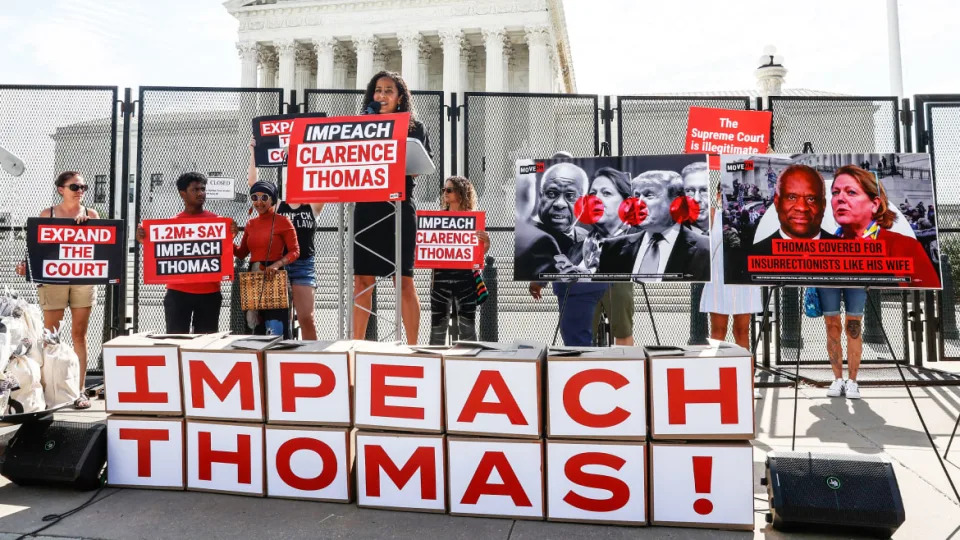
Executive Director of MoveOn.org Rahna Epting speaks at a demonstration where MoveOn.org delivered over 1 million signatures calling for Congress to immediately investigate and impeach Clarence Thomas at the US Supreme Court on July 28, 2022 in Washington, D.C.Jemal Countess / Getty
Now, if Crow did take business deductions for the value of the luxury vacations provided to the Thomases, he would have opened up another can of worms for himself tax-wise. That’s because Crow has publicly stated he did not discuss any business before the court with Justice Thomas.
If that is true, then it is possible that Crow falsified his income tax returns by expensing the cost of the vacation provided the Thomases. It’s also possible the vacations provided the Thomas family could be viewed as income to Thomas—since he would be viewed as providing value to Crow through business discussions. To be very clear, this is speculative and none of this is proven, but the possibility alone makes it worth investigating.
What seems much more clear-cut is that Justice Thomas doesn’t seem to think he has to report gifts from wealthy businessmen, who also are generous corporate political donors, like Harlan Crow.
“Not reportable” is the phrase used by Thomas’ attorney/friend Mark Paoletta when he tweeted (incorrectly) about how the tuition payment by Crow to the school attended by the grandnephew was not reportable as a gift.
Such an admission by Paoletta suggests knowledge of gift tax requirements by both Thomas and Crow going all the way back to the 1990s. It also raises additional questions. Was Justice Thomas motivated not to disclose valuable junkets provided to him and his family in order to abet his buddy Crow’s non-filing of gift tax returns and/or expensing of the value of the trips on his tax returns?
Oh me oh my!
Now, Mr. Crow may think he has insulated himself by procuring a golden passport from St. Kitts and Nevis—which is a notorious tax haven and money laundering refuge in the Caribbean. Then there’s the fact that Crow’s yacht, the Michaela Rose, has a registered ownership under an entity called Rochelle Marine Limited—a company domiciled in Guernsey, another notorious tax haven located just off the shores of the U.K.
Mr. Crow clearly has employed some clever tax accountants and lawyers over the years. And we all look forward to the answers he provides to the questions posed by Sen. Wyden but, clearly, Crow has exhibited a predisposition for tax avoidance behavior. Did he cross the line into tax fraud? That is something to contemplate and discuss around the campfire.
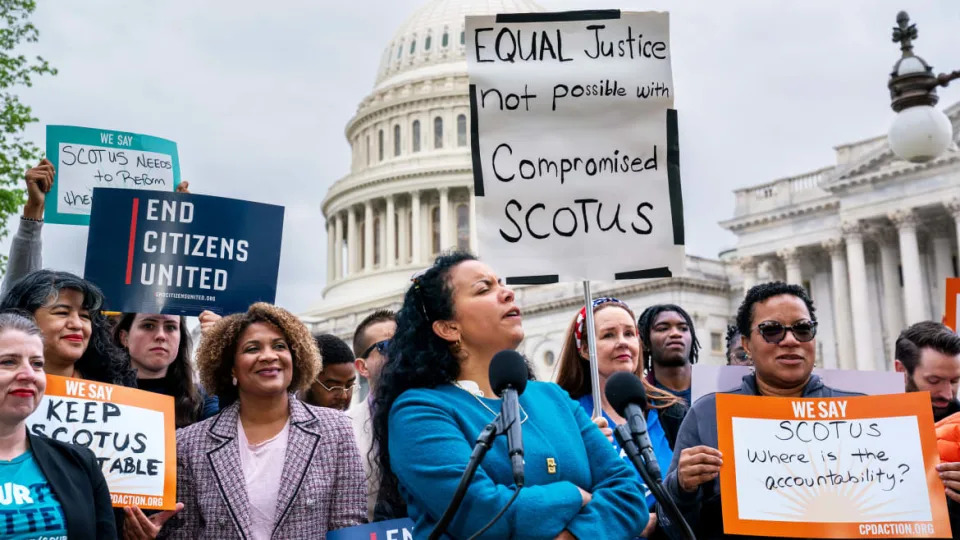
Analilia Mejia of the Center for Popular Democracy, center, joins other activists calling for ethics reform in the U.S. Supreme Court, at the Capitol in Washington, Tuesday, May 2, 2023. Associate Justice Clarence Thomas has been criticized for accepting luxury trips nearly every year for more than two decades from Republican megadonor Harlan Crow without reporting them on financial disclosure forms.J. Scott Applewhite / AP
But why is this question even significant?
It is murky as to whether any of Crow’s business dealings were ever subject to SCOTUS review—even indirectly. What is not unclear are the heavy-duty political campaign contributions made by Harlan Crow.
Has Mr. Crow donated to dark money PACs? We don’t know, because anonymity is the whole point of dark money PACs.
What about corporate political donations?
There is no limit to those given the Citizens United decision, wherein SCOTUS bestowed personhood on corporations and concluded that limiting corporate political contributions was tantamount to limiting freedom of speech—which was unconstitutional.
Might that issue have ever come up when Thomas was sailing on Crow’s yacht or flying on his corporate jet? Justice Thomas voted with the majority in Citizens United, which certainly had to make corporate executives everywhere in the U.S. pleased—even if it opened the door to contributions from overseas, and not just from Caribbean tax havens, and not just from dual passport holders.
That Justice Thomas was unethical in not disclosing receipt of luxury gifts provided to him is transparently obvious, though it seems inconsequential to date. But it does raise the question as to whether those who provide wealthy gifts to civil servants that hold positions of power should face any consequences, particularly when tax responsibilities are clear.
Should wealthy corporate executives who make large political donations to obtain results favorable to their business (or make luxury gifts to powerful people) be held accountable? Bottom line—does the wealth, power, and position of the wealthy insulate them from the consequences of their actions? (Normal tax-paying citizens would certainly face such a reckoning.)
These questions are bigger than just Thomas and Crow. They speak to the integrity of our political systems, and whether ordinary Americans should have to live by different rules than the wealthy and politically powerful.
“No mention of Ginni.’ Conservative activist directed money to wife of Justice Clarence Thomas
John Fritze, USA TODAY – May 5, 2023
WASHINGTON − A well-known conservative legal activist who has helped shape the modern Supreme Court arranged for the wife of Justice Clarence Thomas to receive tens of thousands of dollars for consulting work, according to a report Thursday in The Washington Post.
“No mention of Ginni, of course,” The Post quoted Leo instructing Conway.
The Post reported that Conway’s firm, the Polling Company, paid Ginni Thomas’s firm $80,000 between June 2011 and June 2012 and expected to pay $20,000 more before the end of 2012. It was not clear what the money was for, though Leo told The Post in a statement that it “involved gauging public attitudes and sentiment.”
The revelation was the latest in a series of reports in recent weeks about money and gifts Thomas and his family have received from outside interests. Earlier Thursday, ProPublica reported that GOP megadonor Harlan Crow had paid private school tuition for Thomas’s grandnephew. Last month, ProPublica revealed new details about private jet travel and luxury yacht trips Thomas also accepted from Crow.
In his statement to The Post, Leo explained his desire to keep Ginni Thomas’ name off the paperwork by asserting he has “always tried to protect the privacy of Justice Thomas and Ginni” because of how “disrespectful, malicious and gossipy people can be.”
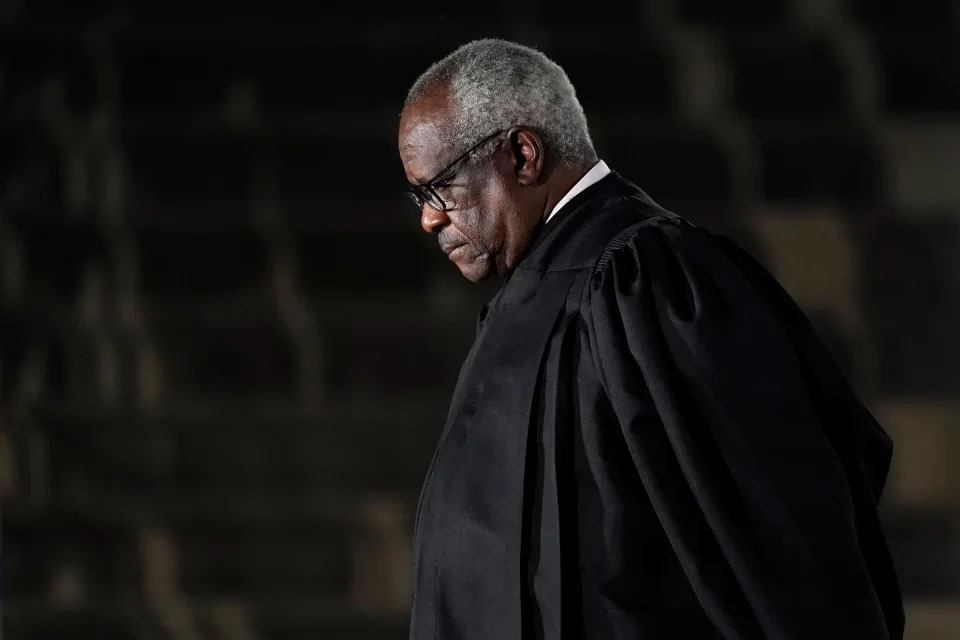
Supreme Court Justice Clarence Thomas listens as President Donald Trump speaks before administering the Constitutional Oath to Amy Coney Barrett on the South Lawn of the White House in Washington, Monday, Oct. 26, 2020, after she was confirmed by the Senate earlier in the evening. (AP Photo/Patrick Semansky)
Clarence Thomas’s problems multiply at Supreme Court
Al Weaver – May 5, 2023
Supreme Court Justice Clarence Thomas is facing a fresh round of scrutiny after the third blockbuster report in less than a month links him financially to GOP megadonor Harlan Crow.
ProPublica reported Thursday that Crow, a Dallas-based real estate developer, paid thousands of dollars in tuition to a private boarding school for Thomas’s great-nephew, whom Thomas has said he raised “as a son.”
Federal ethics laws require the justices to report gifts given to a “dependent child,” but that term is defined to only include the justices’ children or stepchildren. Thomas’s allies have insisted the payment doesn’t violate the disclosure law since it was for Thomas’s sister’s grandson.
But the revelation has only added to the increasing pressure from Democrats for the justices to adopt a binding code of ethics.
“Today’s report continues a steady stream of revelations calling Justices’ ethics standards and practices into question. I hope that the Chief Justice understands that something must be done—the reputation and credibility of the Court is at stake,” Senate Judiciary Committee Chair Dick Durbin (D-Ill.) said in a statement.
When asked during a SiriusXM interview about impeaching Thomas, however, Durbin said “no.” He noted that only one justice, Samuel Chase, had been impeached previously, and Chase was acquitted in the Senate in 1805.
“I don’t think an impeachment is in the works, particularly with the House in a political situation that it’s in today,” Durbin said on “The Briefing with Steve Scully.”
Sen. Richard Blumenthal (D-Conn.), a Judiciary Committee member, argued the matter should be referred to the Department of Justice.
“There’s a potential criminal violation in the misreporting or failure to report certain benefits, gifts and financial transactions. There’s just a drip, drip, drip of additional information that is gravely undermining the Court, but also creating the need for a full factual investigation,” Blumenthal said.
“If [the Justice Department] fails to do so, Congress definitely has a role,” he added.
Thomas did not return a request for comment through a court spokesperson.
Later on Thursday, The Washington Post reported that Leonard Leo, a conservative judicial activist who played a key role in the Supreme Court’s rightward shift, directed tens of thousands of dollars be paid to Thomas’s wife, Ginni, roughly a decade ago.
Leo requested that she not be named in the paperwork, according to the Post. Ginni Thomas, a conservative activist herself, has long insisted that she doesn’t talk about the court’s business with her husband.
Judiciary Committee Democrats have been hamstrung on taking action regarding the court, including on a potential subpoena for Chief Justice John Roberts. He declined an invitation from Durbin to appear at a Tuesday hearing on Supreme Court ethics, noting that it is “exceedingly rare” for a chief justice to give testimony.
That could change if Sen. Dianne Feinstein (D-Calif.), who has been absent for months due to shingles, returns and once again gives Democrats an 11-10 majority on the panel — though even then subpoenaing the chief justice of the Supreme Court would be an extraordinary step.
Thursday’s ProPublica report was the latest financial transaction involving Thomas and Crow to come to light. The investigative outlet last month reported Thomas had accepted luxury trips from Crow, including flying on his private jet, without disclosing the travels.
ProPublica also reported Crow had purchased real estate from Thomas’s mother that Thomas had an interest in.
“The definition of insanity is seeing the same Supreme Court justice violate ethics rules over and over again and expecting him to actually hold himself accountable,” Sarah Lipton-Lubet, president of Take Back the Court Action Fund, said in a statement. “How many more examples of Thomas flouting disclosure rules do our elected leaders need to see before they intervene? Thomas needs to answer for his misconduct. It’s time to subpoena him.”
Republicans, on the other hand, indicated little willingness to wade into the waters related to the justice who has served on the court for 32 years. They say this is an issue for the Supreme Court to deal with and not something that requires congressional oversight. Interfering, they argue, would go against the separation of powers.
“The Supreme Court … writes its own rules and if there is any policing of those rules to be done, I think it ought to be done by them,” Sen. John Thune (S.D.), the No. 2 Senate Republican, told reporters. “I assume the members of the Court, who I have a high level of confidence in, will make the right decisions for the justices on the Court and for the people who work at the Supreme Court in the same way as we make the rules for all members of Congress.”
Sen. Mitt Romney (R-Utah), who recently indicated that he was dismayed by reports of the ethical issues for Thomas, said the Court needs to make ethics changes.
“These revelations with regards to a number of justices, both those appointed by Republicans and by Democrats, suggest that the Court itself needs to evaluate what their disclosure rules are and ethics rules are and methods for enforcing those,” Romney said. “I presume that the chief justice will undertake that.”
Republicans have further portrayed the Thomas scrutiny as a double standard, taking aim at the ethics of the high court’s liberal justices.
They note that liberal Justice Ruth Bader Ginsburg accepted an award in 2010 from the Woman’s National Democratic Club.
They have also pointed to liberal Justice Sonia Sotomayor not recusing herself when the court considered taking up two cases involving book publisher Penguin Random House, despite disclosing payments from the conglomerate for her books. Conservative Justice Neil Gorsuch, who also received payments from the publisher for his book, similarly did not recuse.
Conservative lawyer Leonard Leo reportedly ensured Ginni Thomas’ name was kept off the paperwork.
The nonprofit that was billed filed an amicus brief before the Supreme Court that same year.
A little more than a decade ago, a conservative judicial activist helped Ginni Thomas, the wife of Supreme Court Justice Clarence Thomas, secure consulting work that yielded her nearly $100,000 — all the while asking that her name was left off the financial paperwork, according to a new Washington Post report.
Leonard Leo, a lawyer and conservative legal activist, told then-GOP pollster Kellyanne Conway to bill a nonprofit he advised, Judicial Education Project, and give that money to Ginni Thomas in January 2012, the outlet reported, citing financial documents.
That very same year, Leo’s nonprofit filed an amicus brief to the Supreme Court in a key voting rights case in which a 5-4 majority — that included Thomas — ultimately opted to strike down a component of the Voting Rights Act.
The Post highlighted an opinion that Thomas wrote for the case, in which he favored the same outcome that the Judicial Education Project pushed for alongside other conservative organizations. However, he did not mention the amicus brief submitted by the nonprofit.
The Post said documents show that Leo instructed Conway at the time to “give” Ginni Thomas “another $25K,” noting that the billing information should have “no mention of Ginni, of course.”
“When you funnel tens of thousands of dollars to the wife of a Supreme Court justice and go out of your way to specify that her name must be kept off all records of the transaction, that means you know you are doing something wrong,” Sarah Lipton-Lubet, president of the Supreme Court advocacy nonprofit Take Back the Court, said in a statement shared with Insider.
Leo told The Post in a statement that Ginni Thomas’ work at the Judicial Education Project “did not involve anything connected with either the Court’s business or with other legal issues.”
“Anybody who thinks that Justice Thomas is influenced in his work by what others say or do, including his wife Ginni, is completely ignorant of who this man is and what he stands for,” Leo’s statement read, per The Post. “And anybody who thinks Ginni Thomas would seek to influence the Supreme Court’s work is completely ignorant of the respect she has for her husband and the important role that he and his colleagues play in our society.”
The conservative activist said he kept Thomas’ name off the financial paperwork “knowing how disrespectful, malicious and gossipy people can be,” per The Post.
“I have always tried to protect the privacy of Justice Thomas and Ginni,” he told the outlet.
Leo and Thomas first met when the justice was a clerk in the District of Columbia Circuit, and have been friends for decades, per The New York Times. Thomas is the godfather to one of Leo’s children and has spent time at the activist’s vacation home, The Times reported, while Ginni Thomas considers Leo a mentor, per The Washington Post.
Leo himself has been under recent scrutiny. Politico reported in March that Leo’s personal wealth soared as he started playing a key role in political fundraising and assisting then-President Donald Trump in 2016 with creating a conservative Supreme Court majority.
And on April 6, a nonprofit watchdog organization in Washington accused Leo of acquiring $73 million over six years from nonprofit groups that illegally sent money to his businesses.
Representatives for Ginni Thomas and the Supreme Court, did not immediately respond to Insider’s requests for comment sent outside regular business hours. Leo’s firm, CRC Advisors, and Conway’s website did not immediately respond to similar requests.
Thomas had taken legal custody of his grandnephew at the time and told C-SPAN in an interview he was “raising him as a son.” Tuition at the Georgia boarding school ran more than $6,000 a month, ProPublica reported. Thomas did not note the payments from Crow on his annual financial disclosures.
The revelation was the latest involving Thomas and Crow, who paid for lavish trips and private jet travel for the justice and his wife and who purchased three Georgia properties from Thomas and his family − none of which were reported on disclosure forms officials are required to file to give the public insight into their financial arrangements.
The court did not respond to a request for comment.
In a statement, Mark Paoletta, who has represented Thomas’ wife, Ginni, said the tuition payment was not reportable because disclosure requirements do not cover nephews.
“This malicious story shows nothing except for the fact that the Thomases and the Crows are kind, generous, and loving people who tried to help this young man,” Paoletta said.
What’s the potential impact of the latest Clarence Thomas revelations?
The latest ProPublica story came as Thomas and the Supreme Court are under heightened scrutiny from Congress and outside groups over ethics concerns. The Senate Judiciary Committee held a hearing Tuesday in which Democrats, in particular, slammed the court for a series of recent stories questioning disclosure practices.
But the debate over ethics at the Supreme Court has also become increasingly partisan, and Republican senators at the hearing accused Democrats of highlighting the ethics issues as a way to delegitimatize a court that handed down several controversial and conservative opinions on abortion, guns and religion in recent years.
In response to the initial ProPublica story about travel, Thomas said he was “advised that this sort of personal hospitality from close personal friends, who did not have business before the court, was not reportable.” He said he has “endeavored to follow that counsel throughout my tenure,” Thomas said in a statement, “and have always sought to comply with the disclosure guidelines.”
Justice Clarence Thomas and the Supreme Court are under heightened scrutiny from Congress and outside groups over ethics concerns.
‘Harlan picked up the tab’
It was not clear exactly how much money Crow spent on the tuition at the school, Hidden Lake Academy. ProPublica identified a bank statement for July 2009 that showed Crow paid the tuition for Thomas’ relative that month. Christopher Grimwood, a former administrator at the school, told ProPublica that Crow paid the tuition the entire time Thomas’ grandnephew was a student there.
“Harlan picked up the tab,” Grimwood told ProPublica.
Crow’s office responded with a statement asserting that his family has supported many scholarships and blamed “partisan political interests” for trying to turn an effort to help “at-risk youth” into something “nefarious.”
Thomas and Ginni Thomas have also accepted luxury trips for years paid for by Crow, including international travel on his private jet and yacht, ProPublica reported last month. Crow also purchased three Georgia properties from Thomas and members of his family in 2014, a transaction that Thomas failed to note on his annual disclosure forms.